Many teams equate "buying a lamp" with "having a light source," only to end up with uneven illumination, unknown intensity, and impure bands. A real photochemical light source is a system: the lamp provides spectrum and power, the homogenizer / light guide shapes the spot, the filter tailors the band, the light power meter calibrates at the sample position, and the reactor hosts the light–catalyst–reactant interface.
| Module | Role | Optional equipment |
|---|---|---|
| Lamp | Provides spectrum & power | Xenon / LED source / solar simulator |
| Homogenize & guide | Shapes the spot | Homogenizer, light guide, lamp panel |
| Filter | Tailors the band | Band-pass / long-pass / ND filters |
| Calibrate | Sample-position measurement | Light power / irradiance meter |
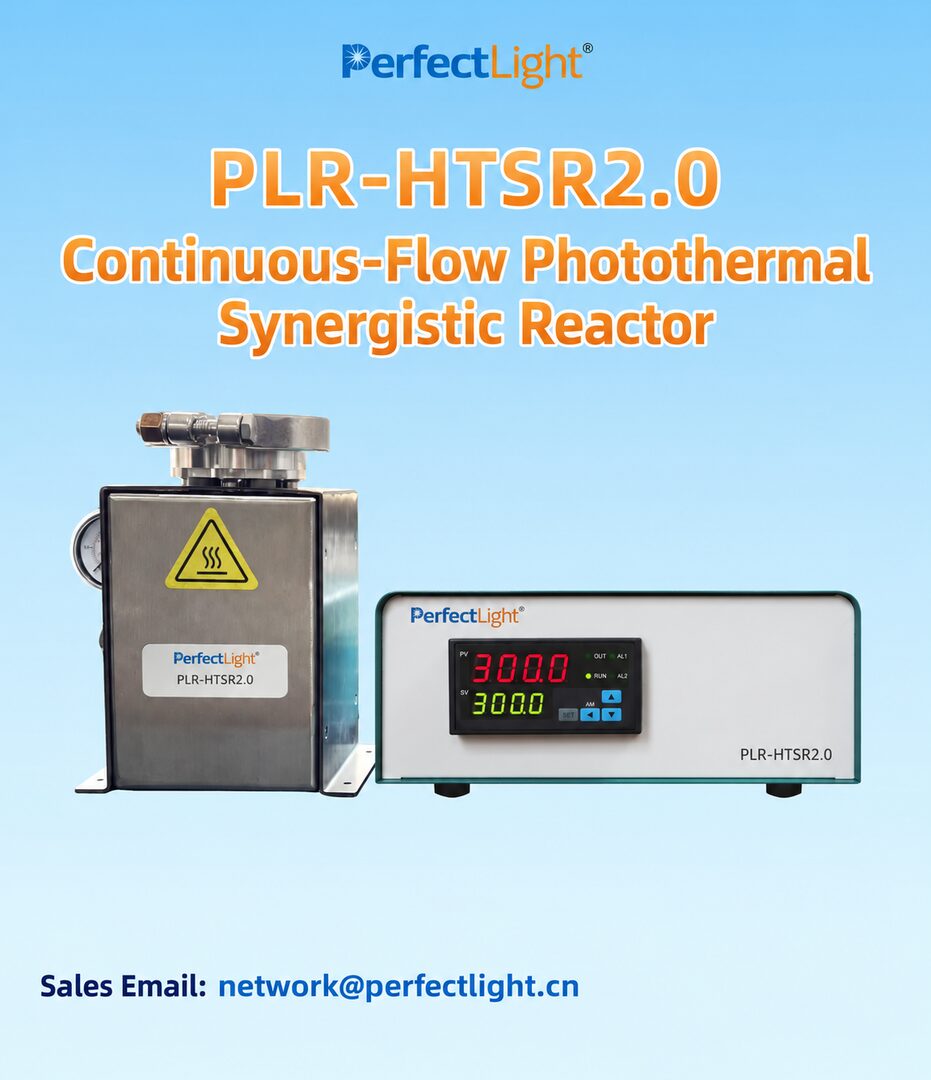
| React | Completes conversion | Photochemical reactor, photocatalytic evaluation system |
First fix the reaction system and phase, then choose the source type, then add homogenization / filtering, and finally calibrate and record with a light power meter. Systems with gaseous products should also integrate online detection (e.g., the μGAS1001 micro-gas reaction evaluation system) to form a "light–chemistry–detection" closed loop.
Contact Perfectlight: Want to build a photochemistry platform from source to reactor? Tell us your system, phase, and target products, and Perfectlight will produce a complete configuration checklist.
Email: network@perfectlight.cn | Contact us
No, it is a system of lamp + homogenization/guiding + filtering + calibration + reactor; missing any link causes uneven light or unknown intensity.
Gas–solid favors coverage and uniformity; liquid–solid favors effective irradiance through the vessel; gas–liquid–solid needs gas circulation and online detection; multi-channel uses large-area or arrayed sources.
Integrate online detection (e.g., the μGAS1001 micro-gas reaction evaluation system) to form a light–chemistry–detection closed loop.
This article does not constitute a performance commitment; specific technical parameters are subject to the actual product documentation and mutual confirmation.