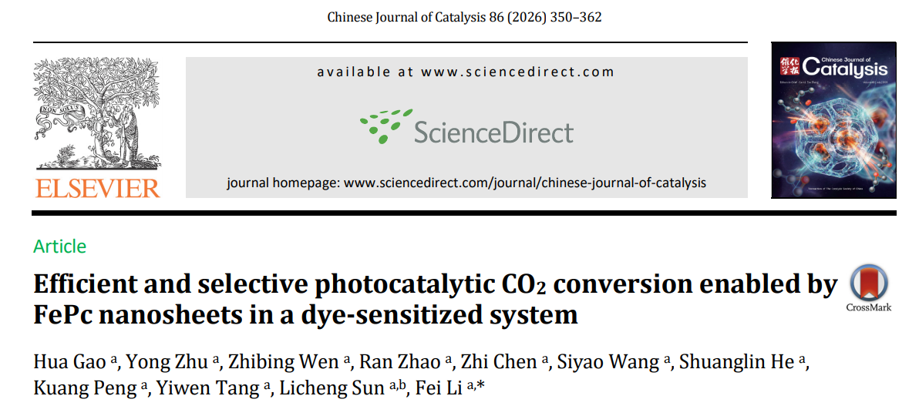
In 2026, the Chinese Journal of Catalysis published the work of Prof. Li Fei's group on photocatalytic CO2 reduction (first author: Gao Hua; DOI: 10.1016/S1872-2067(26)65061-9).
Metal phthalocyanines offer well-defined M-N4 active centers and tunable electronic structures, but bulk FePc suffers from strong pi-pi stacking that hides most active sites. The team prepared ultrathin FePc nanosheets exposing abundant accessible sites for CO2 reduction.
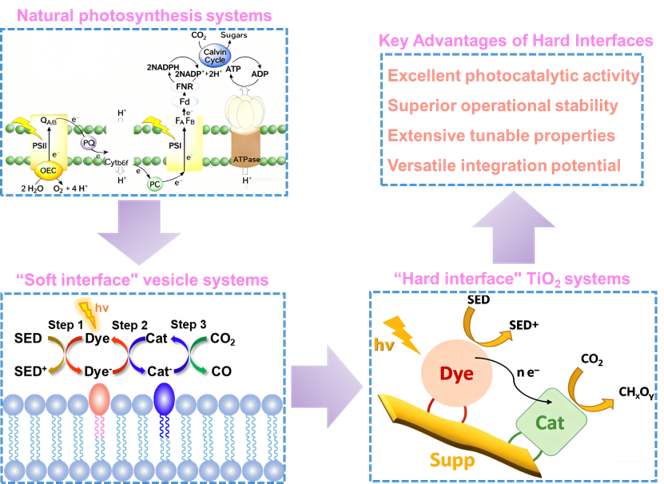
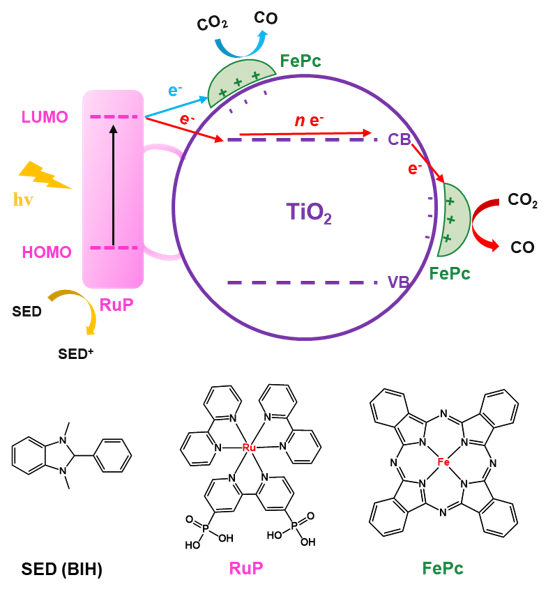
Inspired by natural photosynthesis - where light-harvesting complexes and catalytic centers are precisely arranged in thylakoid membranes - the RuP-TiO2-FePcNSs assembly uses TiO2 as an electron relay, creating a dual electron-transfer pathway that efficiently separates charges and shortens the distance between photosensitizer and catalyst.
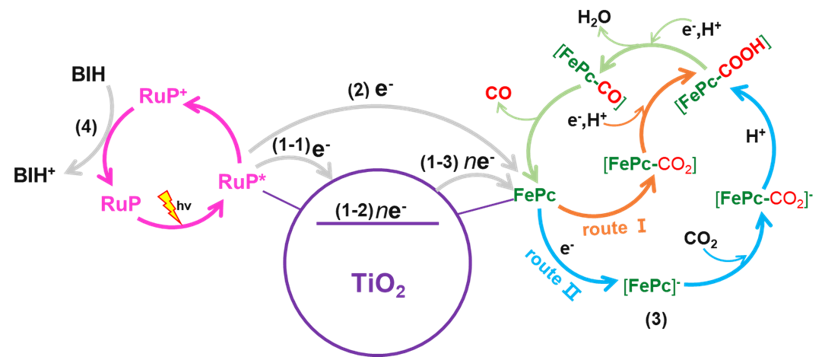
The system delivers a CO production rate of 27.3 mmol g-1 h-1 with >98% selectivity, and excellent stability: a turnover number TONCO of 1363 over 100 h of cycling. Mechanistic studies point to an oxidative quenching pathway and the key role of the *COOH intermediate.
Combining molecular-level site exposure with a bio-inspired soft interface provides a practical design for selective, durable solar-driven CO2-to-CO conversion.
Chinese report: CJC杂志:李斐课题组染料敏化体系实现高效光催化二氧化碳还原.