Photoelectrocatalysis (PEC) superimposes an external bias on illumination to separate charges; the source is not just "lighting up" but must precisely couple with the three-electrode workstation and the photoelectrode fixture in space: the light must hit the working-electrode window accurately, and the illumination on/off moments must align strictly with current recording (often via shutter synchronization). A PEC light source therefore emphasizes geometric coupling and synchronous control rather than raw optical power.
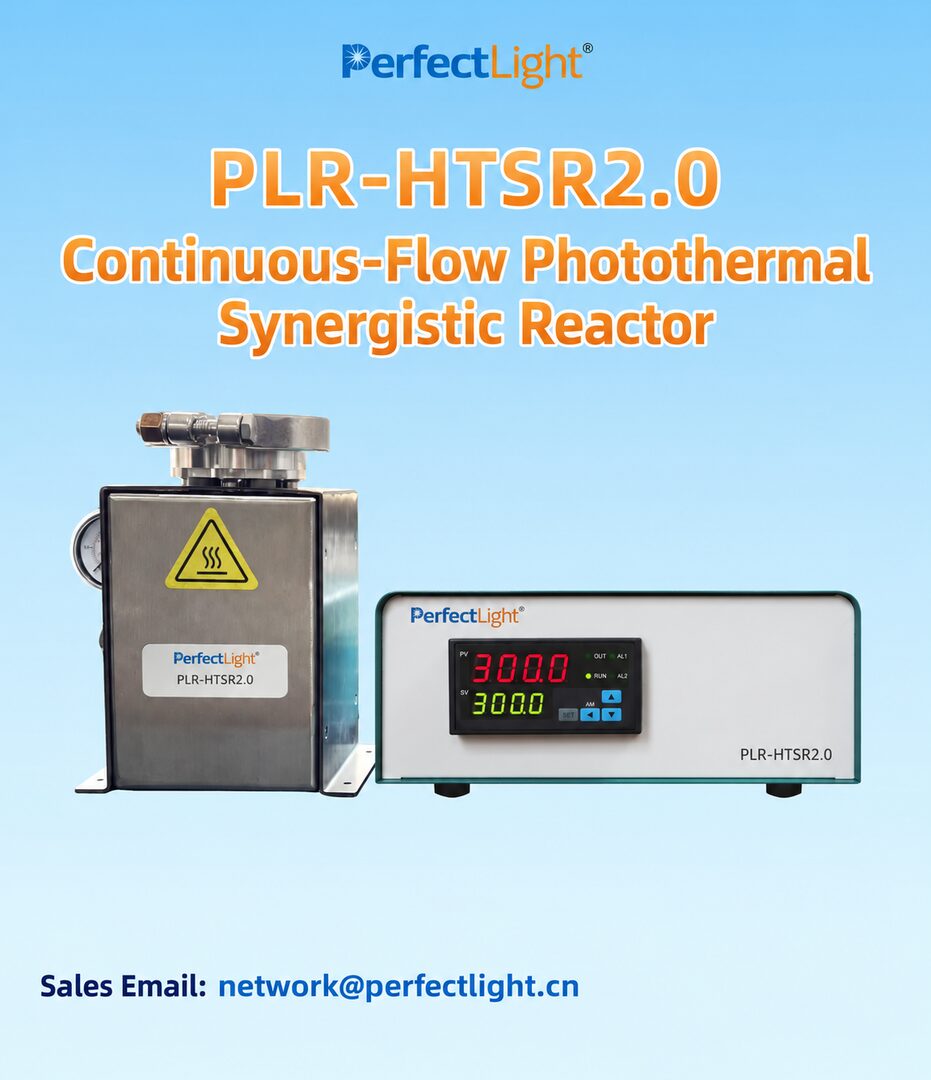
In thermo-photocatalytic synergy, part of the photons are absorbed by the catalyst for excitation while part convert to heat to drive the reaction; the source plays both "light field" and "thermal field" roles. Such a thermo-photocatalytic light source must watch the temperature distribution and reachable temperature across the irradiated surface, avoiding local overheating that distorts product distribution or damages the device.
For PEC, prefer a xenon or LED source that can synchronize with the electrochemical workstation; for thermo-synergy, you need a large-area / high-uniformity source balancing irradiance uniformity and controllable thermal field. Both benefit from a complete set of filters and calibration equipment to close the loop.
Contact Perfectlight: Doing PEC or thermo-synergy, and the source always fights the electrode/reactor? Describe your setup, and Perfectlight will help you with source–electrode coupling and thermal-field configuration.
Email: network@perfectlight.cn | Contact us
The light must hit the working-electrode window accurately, and illumination on/off must align with current recording via shutter synchronization—geometric coupling and synchronous control.
The source supplies both a light field and a thermal field; control the temperature distribution to avoid local overheating that distorts product distribution or damages devices.
Both need sample-position irradiance measurement, band filtering, and treating the source–electrode/reactor as an integrated design.
This article does not constitute a performance commitment; specific technical parameters are subject to the actual product documentation and mutual confirmation.