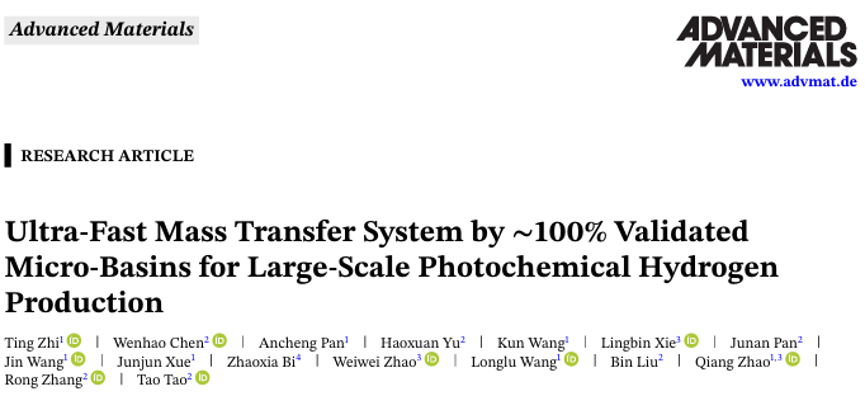
In August 2026, Advanced Materials published work from Prof. Zhi Ting, Wang Longlu and Zhao Qiang (Nanjing University of Posts and Telecommunications) with Prof. Liu Bin and Tao Tao (Nanjing University) on large-scale solar photochemical hydrogen production. DOI: 10.1002/adma.74456.

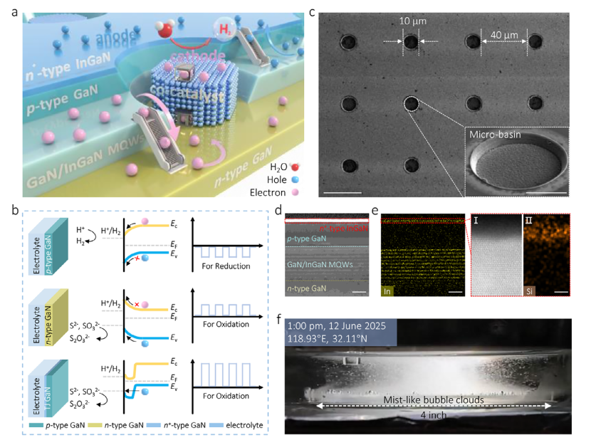
The team built a GaN/InGaN multi-quantum-well photochemical diode with an ultrathin n+-InGaN tunnel junction to drive hole transport toward the electrolyte, plus a periodic micro-basin array (about 10 um diameter, 40 um pitch, 1.4 um depth) loaded with non-noble Ti/Al/Ni cocatalyst.
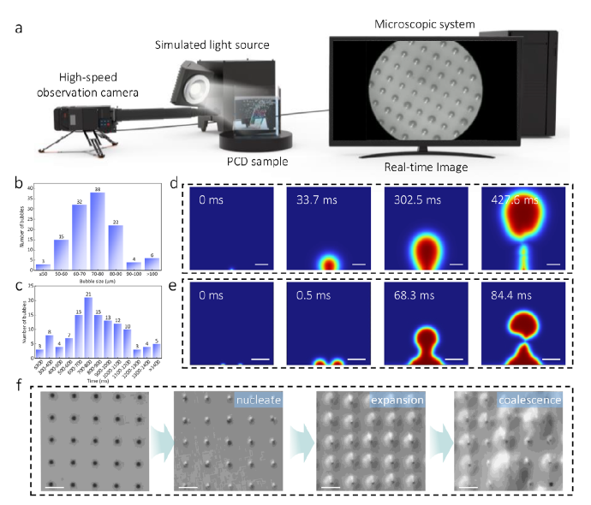
The optimized device reached 177.53 umol h-1 cm-2, about 89 times a planar diode and 28 times a micro-basin device without cocatalyst, with no obvious decay over 50 cycles / 100 h. High-speed microscopy tracked 4,660 micro-basins, all showing bubble nucleation or growth. Bubbles detached at 70-80 um within 700-800 ms, with coalescence-induced self-jumping refreshing the gas-liquid-solid interface.
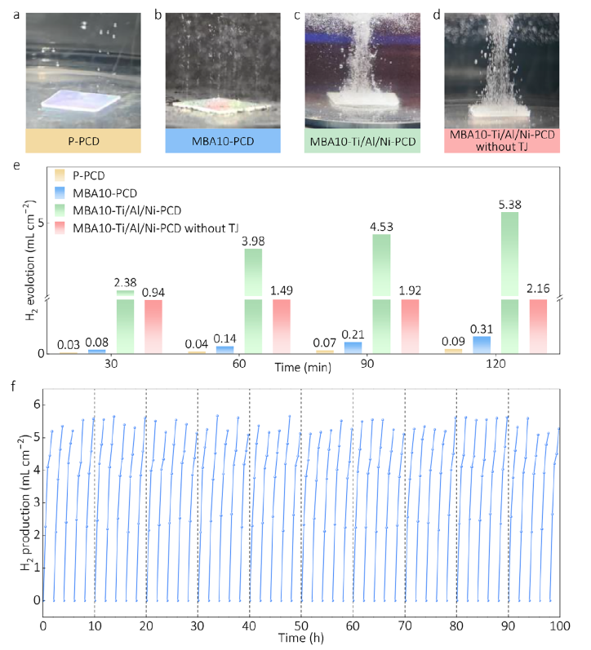
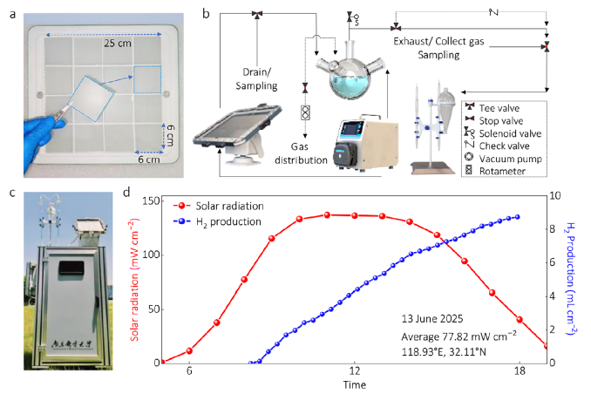
Multiple diodes were integrated into a 25 x 25 cm panel. Under natural sunlight averaging 77.82 mW cm-2, the system produced about 5.5 L of H2 in a single day, demonstrating a route from lab devices to modular solar hydrogen systems.
The study addresses carrier-transport and bubble-mass-transfer limits that emerge when photochemical devices are scaled, offering a structural design paradigm for GaN-based photoelectrochemical systems, water electrolysis and other gas-evolving reactions.
Chinese report: Advanced Materials:微盆阵列破解传质瓶颈,推动光化学制氢规模化.