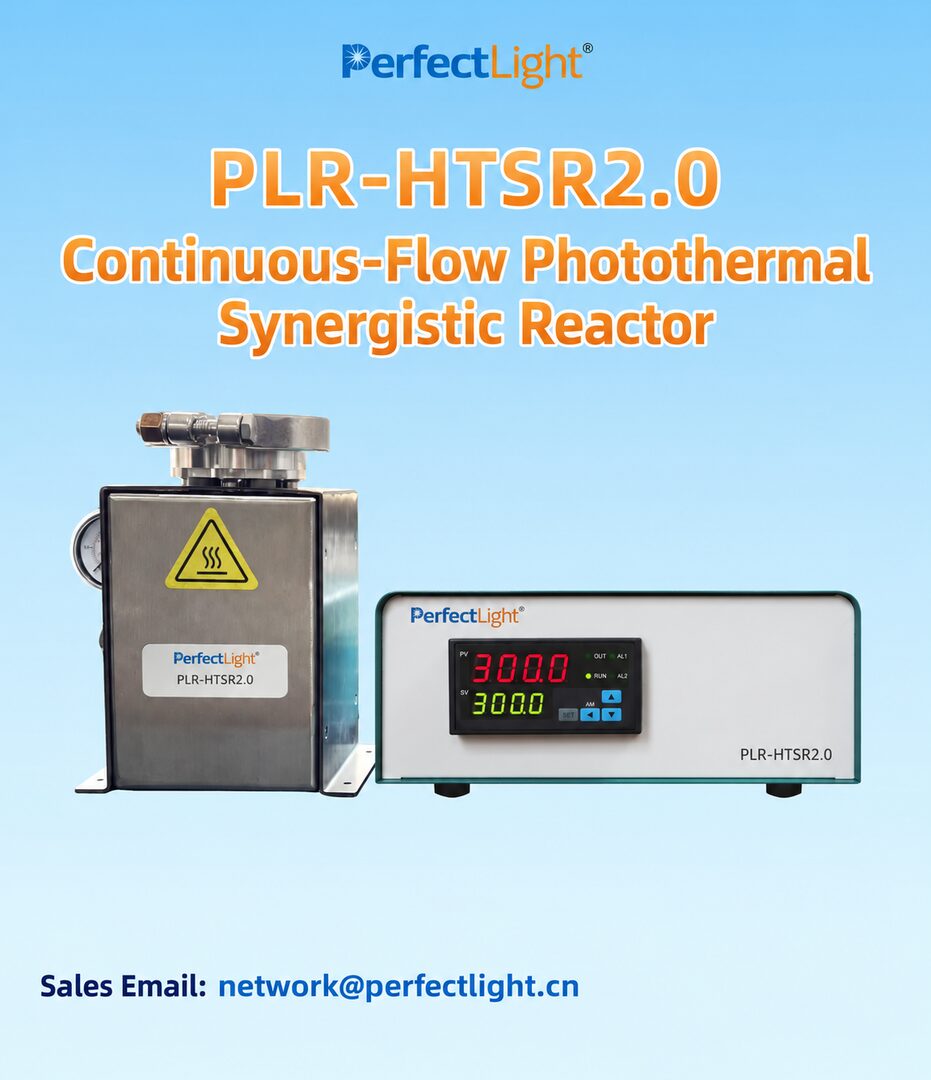
Photochemical synthesis differs from evaluation—it must produce separable products. The vessel needs to seal against volatilization, shield light against side reactions, control temperature, and allow sampling; the Photochemical Synthesis Reactor Device is designed for exactly this.
General-purpose photochemical reactors (such as rotary and multi-channel types) lean toward activity evaluation; the Photochemical Synthesis Reactor Device leans toward product synthesis and separation, emphasizing volume, sealing, and post-processing friendliness.
Synthesis-grade photoreactions can use the PLS-P8 Rotary Photochemical Reactor for small trials, or the PLR PMCD-G20 Plate-Type Microchannel Photoreaction Device for continuous-flow synthesis, then scale up in a reactor.
Free consultation: Stuck producing quantity only in small test tubes? Perfectlight's Photochemical Synthesis Reactor Device gives you a synthesis-grade vessel, advancing photoreactions from evaluation to preparation.
Tel: 400-1161-365 / 010-62128921 Perfectlight Official Website
It must seal against volatilization, shield light against side reactions, control temperature, and allow sampling—features built into the Photochemical Synthesis Reactor Device.
General reactors focus on activity evaluation; the synthesis reactor emphasizes product synthesis, separation, volume, sealing, and post-processing.
Pair with the PLS-P8 Rotary Photochemical Reactor for trials or the PLR PMCD-G20 for continuous flow, then scale up in the reactor.
This article does not constitute a performance commitment; specific technical parameters are subject to the actual product documentation and mutual confirmation.
}}]}