In the forefront of modern research on energy chemistry and environmental management, multiphase catalytic reactions occupy a significant position. Whether it is reducing CO₂ to high-value fuels or achieving efficient methane reforming through photothermal synergy, the precise control of gaseous reactants is always a primary challenge for researchers. For many newcomers to these experiments, the most intuitive difficulty often stems from the “rigidity” and “uncertainty” of gas components: relying solely on pre-mixed gas cylinders not only limits the flexibility of adjusting component ratios but also often leads to concentration fluctuations due to component stratification or pressure changes. In this context, what role does the dynamic gas mixing instrument play? It becomes a central topic in constructing a standardized evaluation system.
From a fundamental scientific perspective, a dynamic gas mixing instrument is essentially a precision management system based on mass flow control. Unlike traditional static mixing methods, it does not depend on complex pressure balancing. Instead, it uses multiple independent mass flow controllers to blend feed gases and diluents in real time according to preset ratios. This “mix-on-demand” feature provides a high degree of operational flexibility. For example, in photothermal CO₂ hydrogenation experiments, researchers often need to explore how different H₂ to CO₂ ratios affect product selectivity. With the PLD-DGCS 05 multi-component dynamic gas mixing instrument, researchers can directly set the flow rates of up to eight gases on a seven-inch touchscreen, instantly switching from syngas mode to pure dilution mode. This high level of flexibility allows a single experiment to cover parameter matrices that previously required multiple cylinders, greatly shortening the catalyst screening cycle.
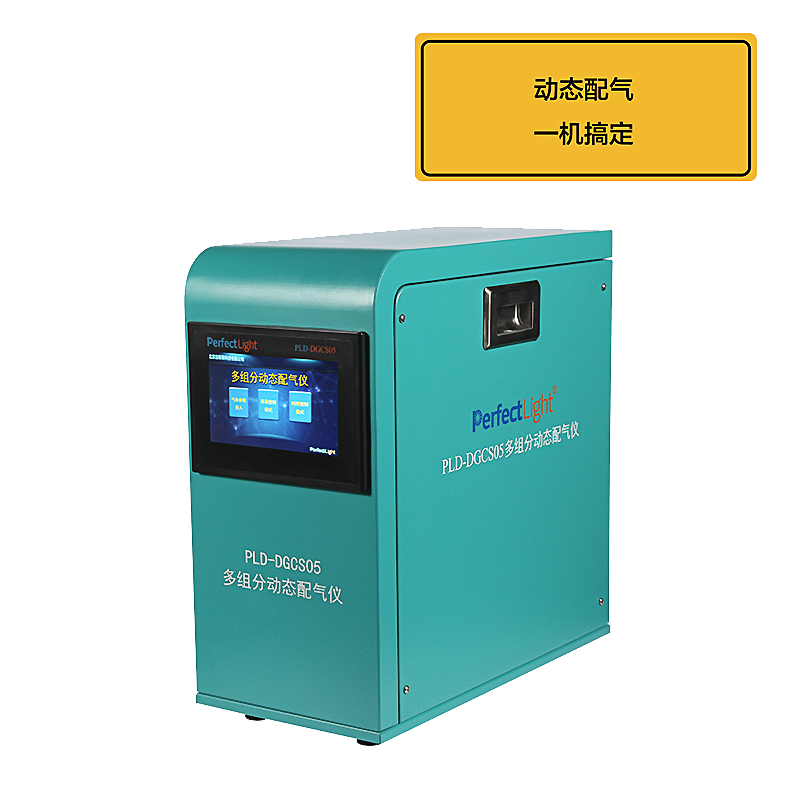
In real research applications, dynamic gas mixing instruments are not only proportion controllers but also simulators of complex conditions. Take, for example, the catalytic degradation of VOCs (volatile organic compounds). The concentration of waste gases to be treated is typically at the ppm level and accompanied by complex humidity fluctuations. To replicate such extremely low and stable pollutant environments in the laboratory, dynamic gas mixing instruments demonstrate irreplaceable technical advantages. They can prepare standard gases with a linear regression coefficient greater than 0.999 through high-precision flow dilution, used for calibrating downstream gas chromatography or mass spectrometry. Even more valuable is their temporal control function, which in high-end devices like the PLD-DGCS 05 has become standard: by presetting programs, the system can achieve linear or rapid changes in gas composition over time, simulating concentration fluctuations in industrial flue gas emissions. This is crucial for examining catalyst resistance to non-steady-state conditions and deactivation mechanisms.
As experimental paradigms advance towards high pressure and multi-field coupling, gas mixing systems also face stringent engineering challenges. When reaction systems need to operate at several megapascals to enhance mass transfer efficiency, ordinary mixing devices may fail due to excessive back pressure, leading to flow inaccuracies or even backflow. To meet such extreme physical conditions, the PLD-HGCSO20 high-pressure automatic gas mixing device shows its depth of integration in both safety and precision. This system employs integrated PLC control, ensuring constant component supply under dynamic pressurization and using built-in pressure sensors for linked monitoring, with a maximum outlet pressure of up to 2 MPa. This precise control of pressure allows researchers, when conducting methane dry reforming (DRM) or photothermal Sabatier reactions, to ensure that the gas partial pressures in the reactor remain in a controllable thermodynamic state, preventing safety hazards or data artifacts caused by pressure fluctuations.
Moreover, dynamic gas mixing instruments play a pivotal role in the standardized chain of environmental monitoring. When dealing with corrosive gases such as NOx or SO₂, the corrosion resistance of internal tubing materials, gas tightness, and the efficiency of purging residual gases directly determine whether cross-contamination occurs in subsequent experiments. Professional-grade equipment typically uses 316 L stainless steel tubing and combines high-precision digital chips for spectral and flow characteristic calibration. This meticulous attention to “every inch of airflow,” coupled with flow calibration under standard conditions (0 °C, 101.325 kPa), ensures that experimental data is scientifically comparable across different laboratories and regions.
In summary, the research value of dynamic gas mixing instruments has evolved from simple “gas dilution” to “multi-dimensional gas-phase environment simulation.” Whether it is the high-throughput multi-component flexible control represented by the PLD-DGCS 05 or the high-pressure condition adaptation represented by the PLD-HGCSO20, each iteration of precision gas mixing equipment helps peel away the layers of experimental noise. It is these hidden power sources behind the lab bench that guide researchers in capturing the microscopic moments of chemical bond cleavage and formation in the symphony of light and matter, laying a solid scientific foundation for reshaping the global green chemical landscape.
Recommended
news