In the forefront of current research on energy chemistry and environmental management, gas-solid catalytic reactions hold a very high significance. Whether it is reducing CO₂ to high-value fuels through artificial photosynthesis, or achieving efficient methane reforming via photothermal synergy, the precise control of gaseous reactants is always the primary variable determining the accuracy of kinetic experiments. For researchers on the front lines of science, if the ratio of feed gases cannot be flexibly and precisely adjusted, then the exploration of product selectivity and the calculation of active sites lose their scientific comparability. In this context, the surge in market demand for dynamic gas mixing instruments is essentially an inevitable result of the transition in multiphase catalytic research from qualitative exploration to precise measurement.
From a fundamental scientific perspective, traditional static gas mixing methods primarily rely on pre-mixed gas cylinders. Although simple, this approach faces clear limitations in practical research: on one hand, researchers often need to explore the effects of different H₂-to-C ratio and different oxygen partial pressures on catalytic reactions. Relying solely on cylinders would fill the laboratory with hundreds or even thousands of gas bottles with varying components, which is costly and cumbersome to manage; on the other hand, long-term storage of pre-mixed gases can cause stratification of heavier components, leading to fluctuations in output concentration as pressure decreases. Therefore, devices capable of real-time dynamic preparation of target gas mixtures have become a necessity in modern laboratories. For example, in photothermal CO₂ hydrogenation or Sabatier reactions, researchers often require a system that integrates multi-channel gas management and high-precision flow mixing. The PLD-DGCS 05 multi-component dynamic gas mixing instrument is designed to address this challenge. It employs mass flow mixing and can support real-time blending and dilution of up to eight feed gases. This “mix-on-demand” feature allows researchers to quickly obtain different gas mixtures through software switching in a single experiment, significantly shortening the catalyst screening cycle.
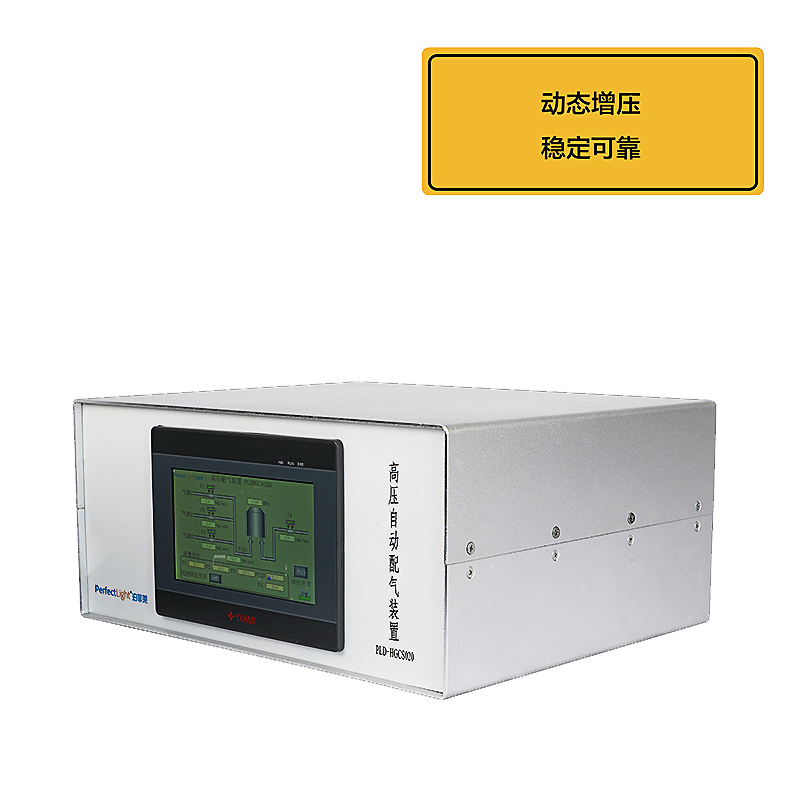
As experimental paradigms advance toward high pressure and continuous flow, the engineering performance requirements for gas mixing systems become even more stringent. In typical thermal catalytic or photothermal synergy systems, increasing reaction pressure generally helps accelerate molecular collisions, enhancing reaction yields and facilitating the liquefaction and separation of gaseous products. However, maintaining constant component ratios under several megapascals of pressure poses a huge challenge in terms of pressure control accuracy and safety. To meet the demands of such extreme physical conditions, the PLD-HGCSO20 high-pressure automatic gas mixing device demonstrates its adaptability in complex scenarios. This device uses integrated PLC control and can achieve a maximum outlet pressure of up to 2 MPa. Compared to traditional manual pressure regulation, its dynamic pressurization mode not only ensures absolute accuracy in gas ratios within the reactor but also provides greater safety redundancy when handling flammable or toxic gases.
In real-world environmental monitoring and VOCs (volatile organic compounds) degradation applications, the role of gas mixing instruments extends beyond simple ratio adjustment to becoming simulators of complex conditions. Industrial waste gases to be treated are often at extremely low concentrations (ppm level) and accompanied by complex concentration fluctuations. To verify the catalyst’s resistance to shock, researchers need to simulate non-steady-state emission processes. The temporal control mode of the PLD-DGCS 05 allows users to preset programs so that gas composition changes linearly or switches rapidly over time, thus replicating highly realistic flue gas environments in the laboratory. This mastery of “dynamic evolution,” combined with all-glass or stainless steel high-inert tubing designs, effectively avoids cross-contamination and metal adsorption errors, providing a reliable physical basis for accurately calculating the solar-to-chemical energy conversion efficiency (STC).
In summary, the research value of dynamic gas mixing instruments has evolved from simple “gas dilution” to “multi-dimensional gas-phase environment simulation.” Whether for rapid gradient screening of multi-component concentrations in basic research or stability verification under high pressure and high flow in pilot-scale expansion, each iteration of precision gas mixing equipment strengthens the experimental foundation of catalytic science. It is these hidden power sources behind the lab bench that guide researchers in capturing the microscopic moments of chemical bond cleavage and formation in the symphony of light, heat, and matter, providing indisputable data support for reshaping the global zero-carbon chemical landscape.
Recommended
news