Behind the scenes of modern industrial production, the management of volatile organic compounds (VOCs) remains a long-term and arduous battle. Whether in fine chemicals, spraying, printing, or leather processing, these gases, which emit odors and possess biological toxicity, not only directly threaten human health but also serve as key precursors to ozone and fine particulate matter (PM2.5). For readers with a foundational research background, the challenge in handling VOCs often lies not in their destruction, but in the efficient destruction of gases with “extremely low concentration and extremely high flow.” In this context, catalytic degradation adsorbents for VOCs, as functional materials that combine concentration and oxidation, are gradually becoming a core solution to the challenge of low-concentration waste gas treatment.
From the perspective of physical chemistry, traditional VOC treatment technologies can be divided into two main categories: “transfer” and “destruction.” Activated carbon adsorption is a typical transfer technology, with the advantage of quickly capturing dilute harmful molecules into its porous structure. However, its drawbacks are evident: the adsorbent eventually becomes saturated and, without molecular transformation, the spent carbon is often classified as hazardous waste, subject to strict hazardous waste management. On the other hand, destruction technologies like catalytic combustion are thorough but require substantial activation energy to maintain reactions for low-concentration waste gases, resulting in high operational costs. Therefore, scientists have proposed a solution of “capture first, then on-site annihilation,” using adsorption-driven advanced oxidation to achieve in-situ purification of pollutants.
The key to this technology lies in the synergistic effect of the materials. Take, for example, the ZKRT-C adsorptive catalyst developed by the Institute of Chemistry, Chinese Academy of Sciences. This material uses a special synthesis process to deeply integrate highly efficient catalytic components with a high surface area porous substrate. In application scenarios, it first leverages the natural advantages of its porous structure to rapidly concentrate VOC molecules, addressing the issue of short residence times of high-throughput organic waste gases in the reactor. Subsequently, using solar energy or artificial light sources to drive low-temperature catalytic oxidation, the captured organic compounds are directly mineralized into harmless CO₂ and H₂O on the material’s surface. This process not only ensures complete pollutant destruction but also allows the active radicals released during the catalytic process to continuously clean the adsorption sites, achieving “in-situ regeneration” of the adsorbent and extending the material’s usable lifespan to over two years.
At the laboratory research level, quantifying the performance of these new composite materials is a key focus for researchers. Given the complexity of VOC components and the sensitivity of reactions to temperature, pressure, and flow rate, researchers require a precision testing environment that simulates real industrial conditions. In this research context, the PLR RVTF-PM miniature gas-solid catalytic reaction evaluation device demonstrates its value as a professional evaluation tool. This device features an integrated, compact desktop design with precise multi-channel gas flow control, capable of simulating environments with varying concentrations of typical VOCs such as toluene and ethyl acetate. Through its built-in top-illumination high-pressure photothermal reactor, researchers can monitor real-time changes in the catalyst bed’s bulk temperature under illumination and, combined with downstream analytical equipment (such as gas chromatography or mass spectrometry), accurately calculate mineralization rates and turnover frequencies under different photothermal coupling intensities. This rigorous calibration of kinetic parameters provides solid experimental evidence for scaling the materials from milligram-scale samples to industrial-scale beds.
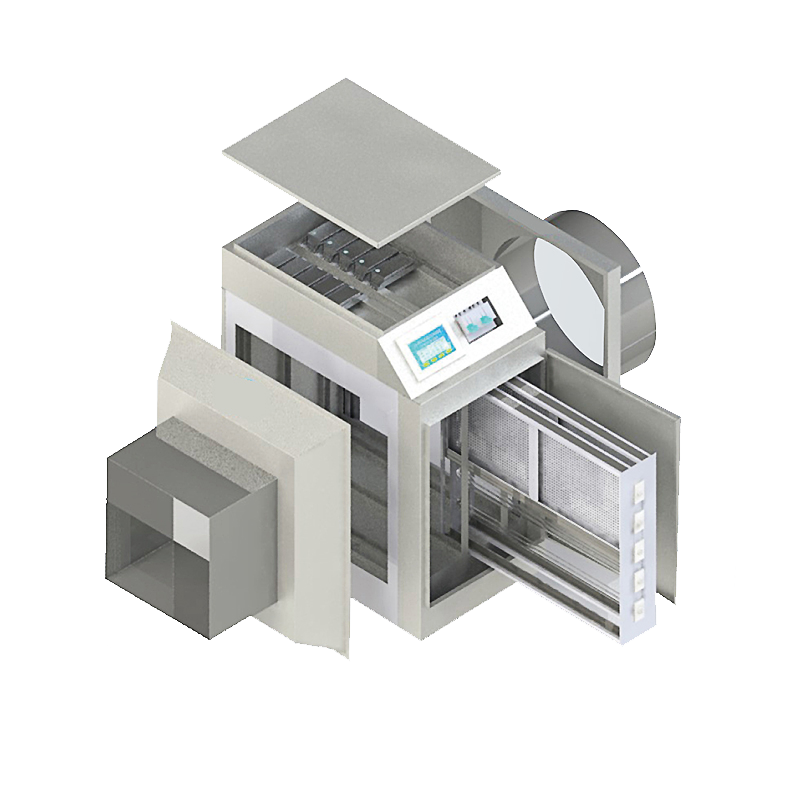
However, transitioning from laboratory to engineering demonstration, the integration of materials and equipment presents the final “mile” challenge. In the field of industrial low-concentration VOC purification, single catalysts often need to be paired with efficient system integration solutions. Current engineering efforts have shown that modular design of waste gas purification equipment can perfectly combine adsorption enrichment with deep oxidation technologies like UV-Fenton. In industrial conditions with flow rates reaching tens of thousands of cubic meters per hour, these systems can monitor the load on the adsorption bed in real time, automatically adjusting light input or auxiliary energy fields to ensure emission concentrations strictly meet national standards. This all-weather, highly stable operational mode significantly reduces maintenance costs and avoids the risk of frequent adsorbent replacement and downtime.
In summary, the application of catalytic degradation adsorbents for VOCs signifies a shift in air pollution control from “simple physical separation” to “precise energy-field-driven” approaches. With experimental devices like the PLR RVTF-PM, which offer multi-parameter monitoring, and high-performance materials like ZKRT-C with in-situ regeneration capabilities, scientists can peel away the complexities of kinetic processes and directly address the essence of chemical bond cleavage and reformation. In this scientific journey toward fresh air, each set of rigorous data and each process optimization represents a definitive step toward green chemistry and a zero-carbon future. As photoelectric, thermal, and materials science converge, these precise tools hidden in purifiers and industrial chimneys are helping humanity reshape a cleaner natural environment.
Recommended
news