In the long journey of seeking alternatives to fossil fuels, hydrogen, with its clean and high-efficiency characteristics, has always been regarded as a core element in the clean energy landscape. Among various hydrogen production pathways, the photoelectrocatalytic (PEC) technology that uses solar energy to directly drive water splitting outlines an almost perfect carbon-neutral cycle. For researchers in this field, evaluating the merits of a photoelectrode material requires not only examining its macroscopic hydrogen production rate across the full spectrum but also delving into the microscopic level to explore how the material responds to photons of different energies. This is precisely the scientific mission of photocatalytic IPCE testing (Incident Photon-to-Electron Conversion Efficiency).
From a fundamental physical perspective, the photoelectrocatalytic process involves the capture of photons, the separation and migration of photo-generated charge carriers (electrons and holes), and the redox reactions across the solid-liquid interface. When the energy of incident photons exceeds the bandgap of the semiconductor material, excited electrons transition to the conduction band, leaving behind holes in the valence band. These charged particles must escape recombination traps in an extremely short timeframe and migrate to the electrode surface to drive chemical reactions. The incident photon-to-electron conversion efficiency is essentially a comprehensive measure of this series of quantum behaviors. By calculating the ratio of current density to incident light power at specific wavelengths, researchers can plot spectral response curves, thereby clearly identifying the wavelength bands where the material excels or where kinetic bottlenecks in charge transport exist.
However, obtaining rigorous and reliable IPCE data in a laboratory context presents stringent engineering challenges. Since the monochromatic photocurrent generated by photoelectrocatalysis is often in the microampere (μA) or even nanoampere (nA) range, environmental electromagnetic noise, indoor light interference, and thermal drift of the current can cause significant signal disturbances. To extract genuine quantum signals from this noisy background, the IPCE 1000 photoelectrochemical testing system plays a crucial role in the current research framework. This system employs advanced lock-in amplifier and chopper coupling technology, leveraging the strong temporal correlation between photocurrent and light signal. By frequency-locking, it filters out unrelated noise, achieving a current detection sensitivity down to the picoampere (pA) level. This high signal-to-noise ratio detection environment ensures that even materials with low quantum yields and wide bandgaps can have their spectral response characteristics precisely calibrated.
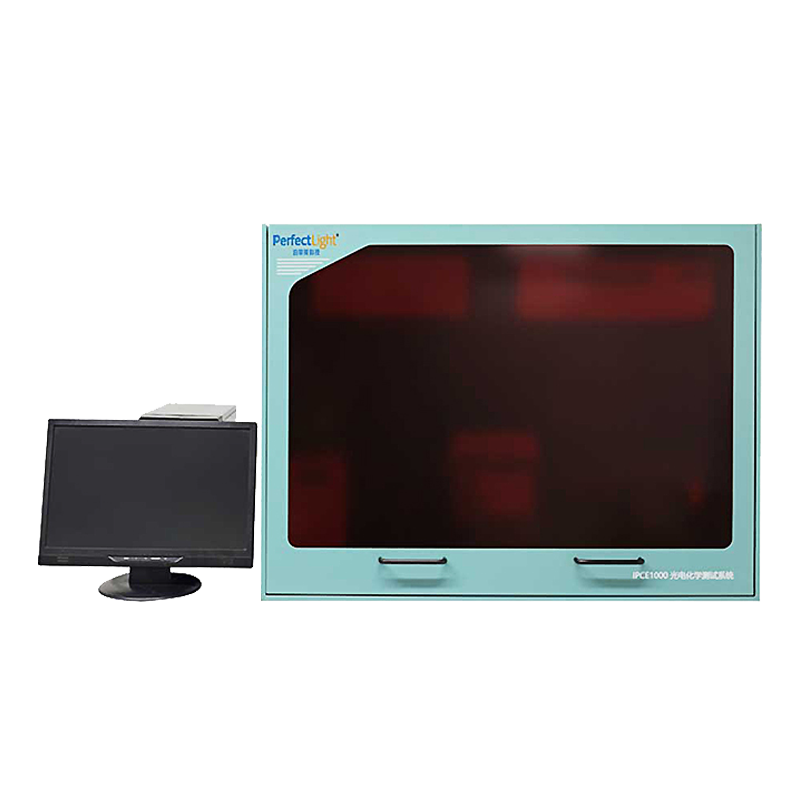
In addition to the precision of signal detection, the accuracy and stability of monochromatic light are also critical concerns in experimental research. The traditional “light source + filter” approach, though simple, cannot achieve continuous scanning across the entire wavelength range. Modern precision evaluation systems prefer high-performance monochromators. For example, the IPCE 1000 features a dual-grating design that ensures wavelength accuracy within ±0.2 nm. This near-precise spectral accuracy allows researchers to finely calculate the band edge positions of the material and the subtle adjustments in quantum yield before and after modification. In actual research, such tests are often combined with apparent quantum yield (AQY) calculations, building a qualitative link from microscopic quantum conversion to macroscopic chemical output, thereby providing scientific justification for band structure engineering of efficient catalysts.
In the pursuit of ultimate testing performance, the compactness of laboratory space and ease of operation are becoming new technical trends. Many research teams, when screening materials, need tools that ensure research-grade data quality while being quickly deployable. The PEC2000 EASY photoelectrochemical testing system is designed to meet this need. By integrating a high-stability xenon light source, a three-electrode reactor, and an automated motion component into a compact platform, it minimizes human-induced variations in light incidence angle and energy distribution, thus reducing experimental deviation. This efficient and user-friendly testing solution not only lowers the technical threshold for photoelectrocatalytic research but also assists researchers in real-time monitoring the evolution of photogenerated charge separation efficiency during long-term stability validation.

In summary, photocatalytic IPCE testing is not only a measuring stick for material activity but also a microscope that reveals the essence of energy conversion. From the delicate capture of weak monochromatic photocurrents to the multi-scale, multi-field coupling of mechanistic investigations, each technological advancement in precision research equipment continuously expands our understanding of artificial photosynthesis. In the journey toward industrial-scale applications such as Hydrogen Farms, the rigorous adherence to experimental paradigms and precise physical parameter calculations are the cornerstone of reshaping the future energy landscape. By leveraging evaluation platforms like IPCE 1000 and PEC2000 EASY, which offer digital feedback and high-precision features, scientists can peel away the veil of physical interference and uncover the scientific truth leading to a zero-carbon future amidst the interplay of light and shadow.
Recommended
news