In the scientific pursuit of energy transition and sustainable development, photochemical conversion technology is regarded as a core pathway for achieving "artificial photosynthesis." Its essence lies in using semiconductor materials or photosensitive molecules to capture solar energy and convert photon energy into the potential energy of charge carriers (electrons and holes), which then drive water splitting, carbon dioxide (CO₂) reduction, or the fine synthesis of small organic molecules. For researchers, photochemical conversion is not only a thermodynamic question about cross-dimensional energy transfer but also a precise interplay involving photon capture, charge carrier dynamics, and mass transfer efficiency at multiphase interfaces.
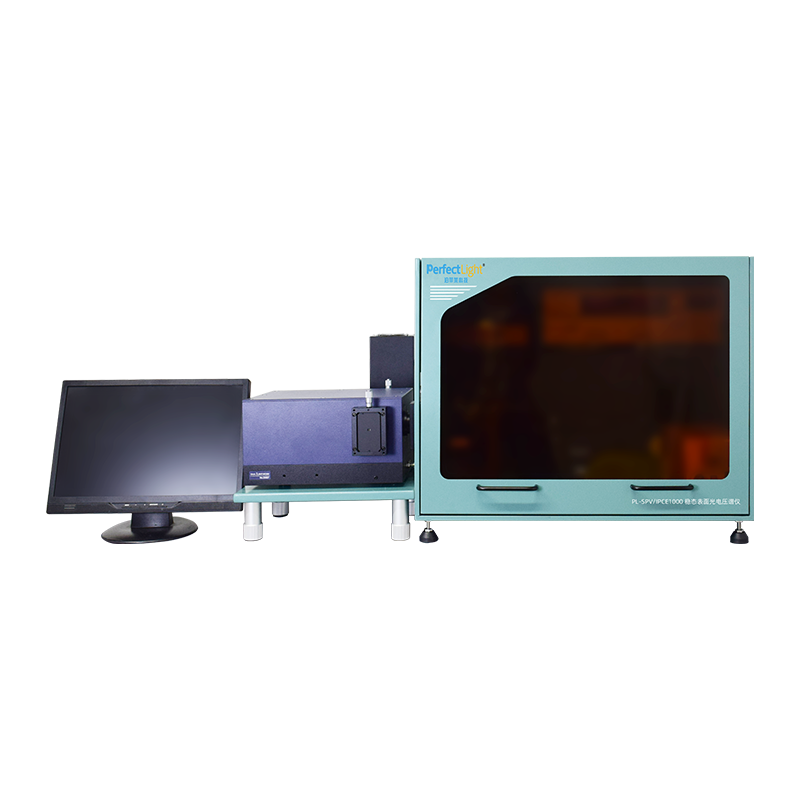
From a microscopic perspective, the efficiency bottleneck of photochemical conversion often lies in the recombination and migration losses of photogenerated charge carriers. When photons strike the catalyst surface to generate excitons, these high-energy electrons must migrate from the bulk to the reactive sites within nanoseconds; otherwise, the energy dissipates as heat or fluorescence. To deeply analyze this process, researchers need non-destructive characterization of the material’s surface photoelectrical properties. The PL-SPV/IPCE1000 steady-state surface photovoltage spectrometer provides a critical physical coordinate in such studies. As a high-sensitivity, non-contact measurement method, this system can precisely determine the material’s conductivity type, bandgap, and carrier diffusion length by detecting voltage changes on the semiconductor surface under illumination. With a measurement sensitivity up to 10⁸ e⁻/cm², far exceeding ordinary spectrometers, it enables researchers to elucidate the role of heterojunction interfacial electric fields in promoting charge separation, thus optimizing the initial pathways of photochemical conversion at the molecular level.
However, from laboratory-prepared nanomaterials to reproducible energy conversion data, a stringent experimental evaluation system stands in between. In photochemical reactions such as complete water splitting or CO₂ reduction, the products often exist as trace gases and are highly susceptible to interference from air infiltration or system re-adsorption. To ensure the scientific rigor of experimental data, the μGAS1001 micro-gas reaction evaluation system has become a standard evaluation terminal in modern photochemical laboratories. This system inherits Porfire Technologies’ extensive experience in airtight glass reaction systems and, through its innovative patented sampling valve island design, achieves fully automated online sampling and injection, with a dynamic oxygen leak rate controlled below 0.1 μmol/h. The extremely high vacuum and airtightness, combined with passive magnetic fan-driven circulation, ensure that reaction products (such as H₂, O₂, or CO) reach kinetic uniformity within 10 minutes. This full-chain control, from "stable light field input" to "precise product analysis," allows researchers to accurately calculate the apparent quantum yield (AQY), providing standardized experimental support for benchmarking photochemical conversion efficiency.
When the research perspective expands from microscopic mechanisms to engineering challenges, efficiency improvements in photochemical conversion increasingly depend on reactor design innovations and multi-field synergistic effects. Photocatalytic oxidation of formaldehyde or cold combustion treatment of industrial exhaust gases requires reaction systems with strong mass transfer capabilities. Traditional static reactors, limited by diffusion rates, often cannot fully utilize the intrinsic activity of high-performance materials. By introducing flow-phase platforms with enhanced mass transfer and incorporating precise temperature control and light feedback, photochemical conversion is gradually breaking free from the confines of "laboratory bottles and flasks," steadily advancing toward large-scale applications and industrial demonstration (such as "hydrogen farm" projects). In summary, the future of photochemical conversion lies in the deep coupling of mechanistic research and precision instrumentation. Through thorough analysis of charge evolution and quantitative control of reaction processes, humanity is progressively approaching the ultimate scientific goal of efficiently capturing and utilizing natural light.
Recommended
news