In modern synthetic chemistry and energy catalysis, light has been regarded as a precise and environmentally friendly "chemical reagent." However, photochemical reactions have evolved from the early laboratory "flask plus light source" setup toward controllable, reproducible systems with industrial potential, with the core pillar being the engineering development of photochemical reactors. For researchers, a photochemical reactor is not merely a vessel; it is an integrated physical-chemical environment that combines light field control, high-pressure sealing, thermal balance, and multi-field synergistic effects.
Traditional photochemical reactions are typically conducted at ambient temperature and pressure. Yet, with advances in CO₂ reduction, artificial nitrogen fixation, and the synthesis of complex pharmaceutical intermediates, reaction systems often require high pressure to overcome gas solubility limitations or to shift thermodynamic equilibria. In this context, the primary engineering challenge is balancing transparency with pressure resistance. The LC-D sapphire photoelectrochemical reactor provides an exemplary engineering solution. Its core advantage lies in the incorporation of a sapphire window, which not only has extremely high transmittance from deep ultraviolet to infrared wavelengths, but also, thanks to its outstanding mechanical strength, allows the system to withstand working pressures up to 10 MPa while delivering light from the external source directly to the reaction center without loss. This design enables photothermal-electro synergistic catalysis (such as high-temperature, high-pressure CO₂ gas-phase reduction) to move from theoretical conception to precisely measurable experimental data.
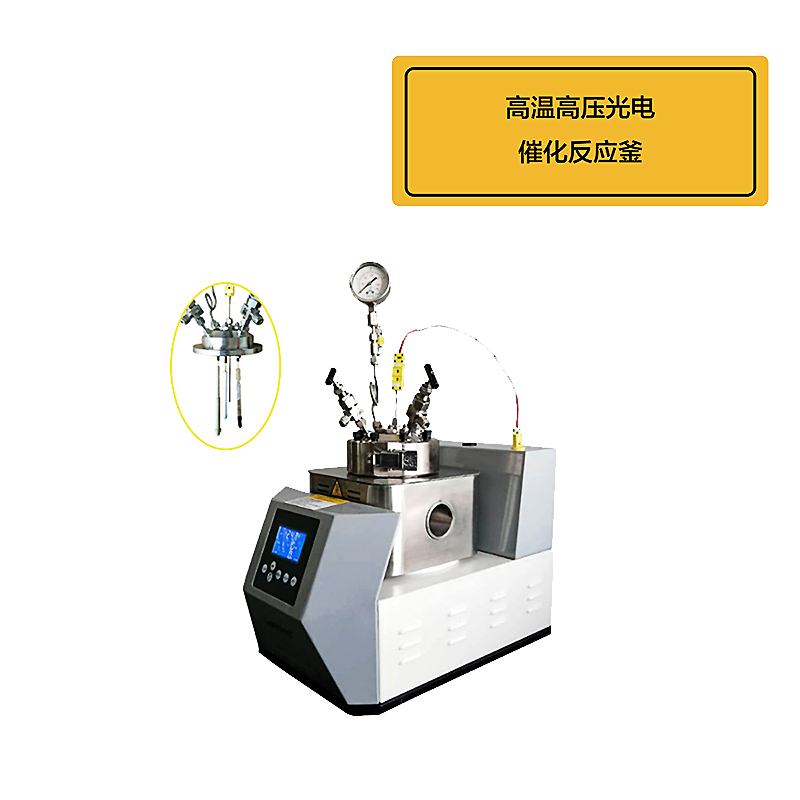
Beyond the pressure dimension, precise thermal management is a key feature that distinguishes photochemical reactors from ordinary high-pressure vessels. Photonic excitation often generates significant heat, and many organic photochemical syntheses or photobiological processes are highly sensitive to temperature. Local overheating can trigger complex radical side reactions or even lead to catalyst deactivation. The LightChem series high-pressure photochemical reactors embody modular design thinking, separating control systems from heating systems and adopting a desktop microstructure with a movable reactor head. Equipped with the MRSC control system, researchers can perform real-time, self-adjusting calibration of internal temperature, stirring speed, and reaction time. More importantly, this series supports top, side, and bottom irradiation modes, combined with an internal platform for powder catalysts, greatly enhancing effective contact at the gas–solid–liquid interface and photon capture efficiency, providing a highly consistent physical benchmark for kinetic studies.
As photochemical reactors transition from small-scale laboratory use to pilot-scale engineering, their forms begin to diversify. Traditional batch reactors often face challenges with limited light penetration depth (the photonic "shielding effect") during large-scale continuous production. To address this, flow-tube reactors and large-volume internal-illumination vessels begin to operate synergistically. In these systems, light sources are typically placed at the center of a cooling trap and arranged for circumferential irradiation, maximizing light utilization. This not only solves heat dissipation issues but also, through series arrangements of tubes and vessels, enables efficient material circulation and real-time product desorption, which is critical for industrial validation of high-value chemicals such as dydrogesterone or vitamin D₃.
In summary, the development of photochemical reactors reflects the shift in modern chemical research from qualitative observation to quantitative analysis, and from single-field processes to multi-field synergistic control. By integrating advanced reactors such as the LC-D or LightChem series, which combine extreme operating capability with precise temperature control, researchers can establish a solid connection between microscopic chemical bond cleavage and macroscopic engineering parameters. This full-chain control from energy input to material conversion is the driving force that enables photochemical technology to advance from laboratory "flasks and vessels" toward the foundation of green chemical industry.
Recommended
news