As a core pathway for achieving "artificial photosynthesis," photocatalytic technology fundamentally utilizes excited charge carriers generated in semiconductor materials under illumination to drive redox reactions, thereby enabling cross-dimensional energy conversion. Unlike traditional thermocatalytic processes that rely on external heating to overcome high reaction energy barriers, photocatalysis operates under extremely mild conditions, typically inducing water splitting or deep mineralization of organic pollutants at ambient temperature and pressure. This "light-for-heat" physicochemical characteristic not only endows the technology with tremendous potential in renewable energy production (e.g., H₂ generation) and environmental protection (e.g., VOC degradation) but also imposes stringent precision requirements on its research evaluation systems.
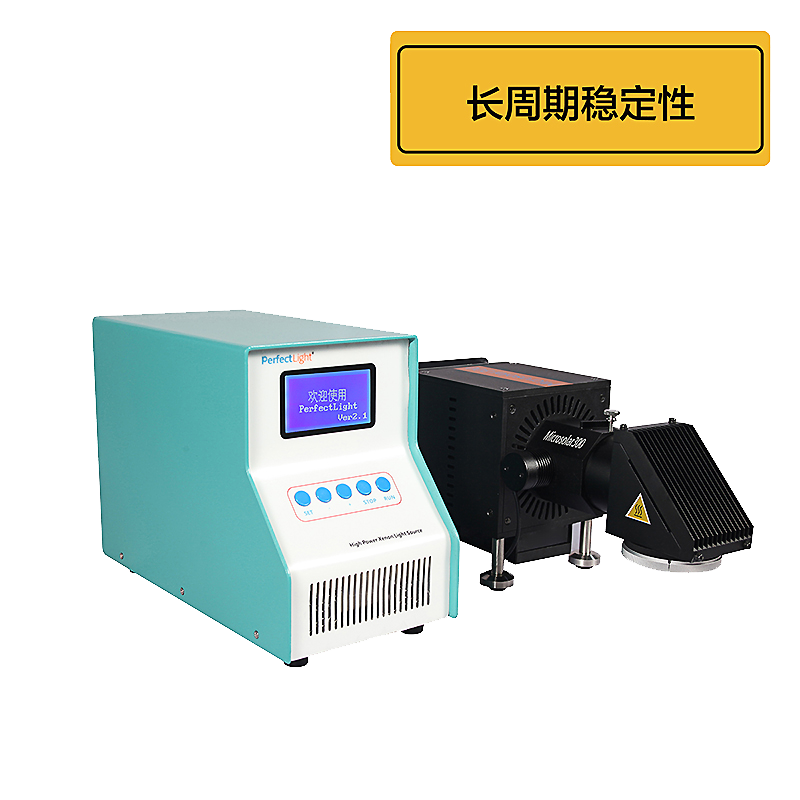
The primary feature of photocatalytic reactions lies in the discreteness of energy matching and the dependency on spectral response. Semiconductor catalysts (such as classical TiO₂ or polymeric g-C₃N₄) can only absorb photons with energies equal to or greater than their bandgap. This means that in experimental settings, the stability and spectral distribution of the light field directly determine the reliability of the apparent quantum yield (AQY). In practice, even minor fluctuations in light intensity can obscure the intrinsic activity of the material. To address this, researchers often employ irradiation systems with precise optical feedback. For example, the Microsolar 300 Xenon Lamp Light Source incorporates core solar simulator technology (TSCS) and an integrated optical feedback module that monitors and adjusts output intensity in real time. This closed-loop control limits long-term irradiation instability to ≤±3%, ensuring that energy input remains constant during long-term stability tests or detailed kinetic studies, thereby eliminating experimental errors caused by natural light source decay.
Beyond light stability, another notable characteristic of photocatalysis is its multivariable coupling complexity. Reaction rates are influenced not only by light intensity but also by excitation wavelength selection, precise reaction temperature control, and mass transfer efficiency. During the early stages of material development, efficiently screening the optimal combination from vast arrays of catalyst ratios and wavelength options is key to improving research productivity. The PCX-50C Discover Multi-Channel Photocatalytic Reaction System provides a high-throughput solution for this challenge. Its modular design with nine LED sources supports custom multi-wavelength parallel comparisons from UV to near-infrared. Moreover, its unique bottom-up vertical irradiation mode, combined with optical-grade quartz flask bottoms, effectively avoids reflection and scattering losses commonly encountered in traditional side-illuminated setups. This structural consistency, coupled with precise water-cooled temperature control from -10℃ to 80℃, allows researchers to accurately decouple photochemical and thermal effects on reaction pathways, significantly enhancing enantioselectivity in temperature-sensitive asymmetric photocatalytic syntheses.
From an engineering perspective, the core advantage of photocatalysis lies in its sustainability. However, scaling from laboratory-scale experiments to large-area industrial applications (e.g., "hydrogen farm" projects) requires overcoming the bottlenecks of light dilution and limited mass transfer. This necessitates that research evaluation move beyond qualitative observations toward quantitative analysis. Efficient gas circulation, ultra-low leakage, and automated data production have become standard in modern photocatalytic laboratories. This chain-like evolution from microscopic mechanisms to macroscopic systems is the driving force enabling photocatalytic technology to transcend laboratory boundaries and advance toward green energy industries. By integrating highly stable energy sources such as the Microsolar 300 with high-throughput reaction terminals like the PCX-50C, researchers are progressively mapping out a clear blueprint for energy conversion within complex "light–electron–chemical" synergistic fields.
Recommended
news