If you’ve seen old photos or films of Los Angeles from the 1940s and 1950s, you might notice the city often shrouded in a hazy “smog.” This wasn’t poetic mist—it was a notorious “scar” of industrial civilization: photochemical smog.
I. The Invisible Killer Under Blue Skies: What Is Photochemical Smog?
In simple terms, photochemical smog is pollution generated by sunlight-driven chemical reactions. Its story began in Los Angeles. In the 1940s, as car ownership surged, vast amounts of vehicle exhaust were emitted into the atmosphere, containing primarily nitrogen oxides (NOₓ) and volatile organic compounds (VOCs).
These substances were harmful on their own, but the transformation occurred under sunlight. Strong ultraviolet rays acted as the “match” that ignited pollution, providing energy for a series of complex photochemical reactions between NOₓ and VOCs, forming new, more irritating pollutants—ozone (O₃)—along with secondary pollutants such as aldehydes and peroxyacetyl nitrate (PAN). The mixture of these compounds created the characteristic blue or brown photochemical smog.
The impact was profound:
On human health: Severe eye and respiratory irritation, coughing, asthma, and long-term lung damage.
On the environment: Reduced crop yields, aging and cracking of rubber products, and acid rain.
Los Angeles’ experience taught us that modern urban pollution has evolved from simple coal smoke to complex atmospheric chemistry influenced by sunlight.
II. Turning Challenges into Opportunities: The Laboratory “Photochemistry” Revolution
Like a coin with two sides, photochemistry, while causing problems in the environment, has been “tamed” by scientists as a tool for solving environmental issues and producing valuable substances. This is artificial photochemical synthesis and catalysis. Its core lies in precisely controlling light-driven reactions in the lab to convert waste into value.
Basic principle: Unlike uncontrolled atmospheric reactions, laboratory photochemistry uses specific wavelengths of light (e.g., LEDs) and highly efficient photocatalysts as a precise “light energy key” to selectively break chemical bonds in target molecules and induce desired transformations.
Applications:
Photocatalytic pollutant degradation: Simulates and accelerates natural self-cleaning processes, using photocatalysts to rapidly decompose organic pollutants in water or air.
Photochemical clean energy synthesis: For example, using sunlight and catalysts to split water (H₂O) into clean hydrogen (H₂), or convert carbon dioxide (CO₂) into fuels like methane.
However, from principle to practice, researchers face major challenges: How to design catalysts that efficiently absorb light? How to ensure every molecule in the reactor is uniformly irradiated? How to scale up smoothly from laboratory flasks to industrial production?
III. Perfectlight Technology: Providing a Full-Chain Solution for Photochemistry
To address these scientific and engineering challenges, Beijing Perfectlight Technology Co., Ltd. leverages its deep technical expertise to provide researchers and industry with a range of powerful and precise tools, turning the potential of photochemistry into reality.
1. Precision Simulation and Screening: PCX-50C Multi-Channel Photochemical Reaction System
In photochemical research, screening optimal reaction conditions (catalysts, light wavelength) is one of the most time-consuming steps.
Core advantage: The PCX-50C functions like a “parallel computing center for photochemical experiments,” capable of running nine simultaneous reactions.
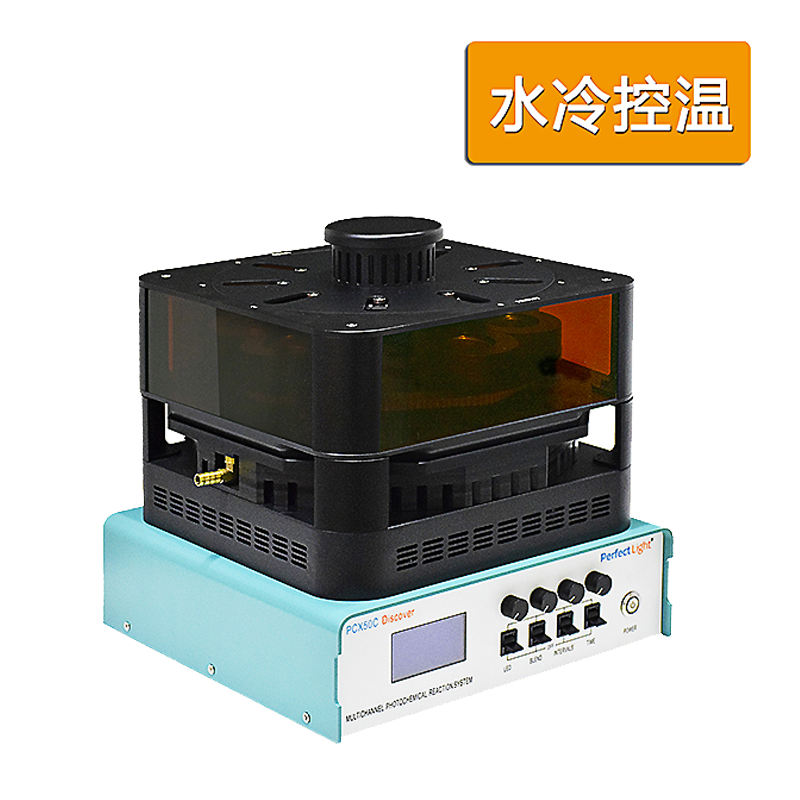
Perfectlight 50C Product
User value: Researchers can complete condition optimization in days rather than weeks or months. The system supports precise wavelength selection from 255 nm to 760 nm across up to 30 wavelengths and enables automated sampling, providing highly standardized, reproducible experiments that lay a reliable foundation for subsequent process scale-up.
2. Mechanistic Study under Harsh Conditions: PLR-GPTR50T Gas–Solid Photothermal Reactor
Many critical energy and environmental reactions, such as CO₂ hydrogenation or methane reforming, occur at gas–solid interfaces and often require combined light and heat.
Core advantage: The PLR-GPTR50T is specifically designed for such photothermal catalysis experiments. It integrates high-precision temperature control (±0.5°C) and a pressure-resistant reaction chamber, allowing real-time monitoring of pressure and catalyst temperature during reactions.
User value: Provides a powerful platform for researchers to explore reaction mechanisms and evaluate catalyst performance under realistic industrial conditions (medium-to-high temperature and pressure). Its compact design and standard gas interfaces also facilitate integration with online analytical equipment (e.g., gas chromatography) for real-time, precise monitoring.
3. Bridging Laboratory to Industrial Scale: Microchannel Continuous-Flow Technology
Perfectlight’s microfluidic microreactor systems address the challenge of photochemistry scale-up.
Core advantage: By generating “Taylor flow” (gas–liquid flow resembling a string of pearls in microchannels), the technology greatly enhances mass and heat transfer, ensuring uniform light distribution.
User value: It successfully transforms batch “kettle-type” reactions into efficient, safe, and controllable continuous-flow processes, clearing the way for scalable industrial photochemistry.
IV. From Understanding to Control: Co-Creating a Clean Future
Looking back, Los Angeles’ photochemical smog was an uncontrolled human experiment. Today, with advanced research instruments provided by companies like Perfectlight Technology, we are shifting from passively enduring pollution to actively applying photochemical principles to solve energy and environmental crises.
From understanding atmospheric pollution mechanisms, to developing clean energy technologies, to degrading environmental contaminants, precise and controllable photochemistry is the cornerstone of a green future. Perfectlight Technology, with its full-chain services—from “data mining → process screening → lab and pilot testing → scaled production”—supports global researchers in exploring photochemistry, making light a force for sustainability rather than a pollutant.
Recommended
news