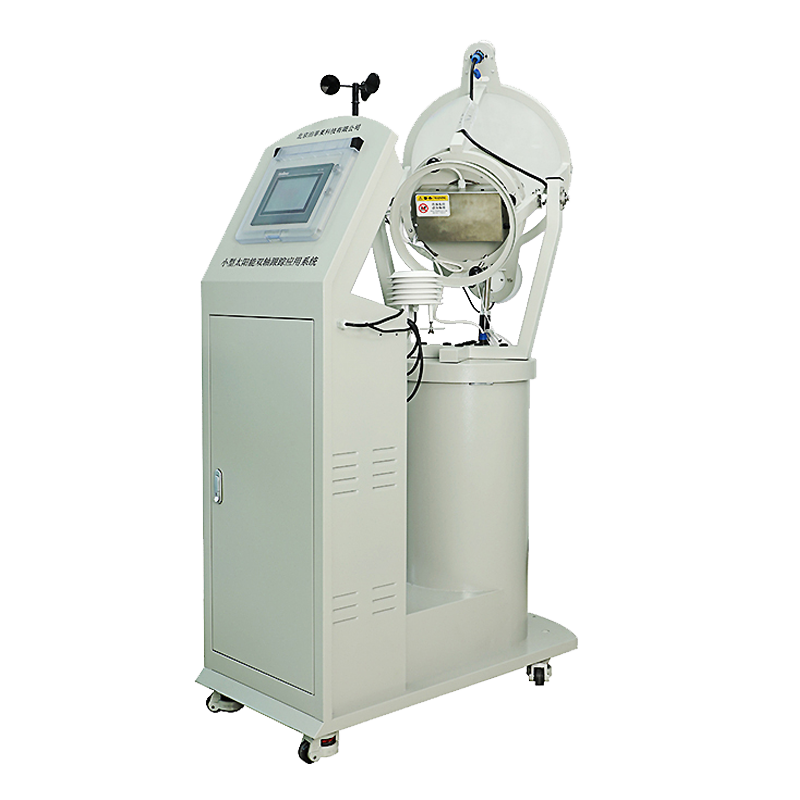
In photocatalytic water-splitting hydrogen production research, improving solar energy utilization is a key bottleneck. The PLR-STR05O Parabolic Trough Flow-Type Photocatalytic Hydrogen Production System adopts parabolic concentrating technology to efficiently collect solar energy, precisely addressing this energy-efficiency challenge.
By leveraging the concentrating characteristics of a parabolic reflector, large-area solar energy is focused into a defined region, generating stronger light intensity or converting it into thermal energy to enhance solar energy utilization;
The sun-tracking system enables automatic azimuth tracking, ensuring the system operates at peak efficiency under both low- and high-light conditions;
The monitoring and control system uses a touchscreen and computer for human–machine interaction, providing real-time monitoring and management to ensure reliable and safe operation;
Components such as the liquid storage tank, circulation pump, and flow channel are carefully designed to meet long-term outdoor operation requirements, ensuring stable product generation and collection;
The main structural frame is constructed from aluminum profiles, offering both aesthetics and reliability. It also features adjustability for elevation and azimuth angle alignment.
▷ Parabolic Concentration, Fivefold Energy Flux
The core of the system employs high-reflectivity mirror-finish aluminum panels (reflectivity >95%) to form a parabolic concentrator. Unlike conventional flat illumination, it gathers large-area sunlight into the center of the tubular reactor, achieving a concentration ratio of over fivefold. This means that under the same solar irradiance, the reaction system receives a much higher light power density, greatly activating catalytic performance.

▷ Automatic Sun Tracking, All-Day Operation
The system is equipped with a high-precision single-axis automatic tracking system (time-controlled + light-controlled), tracking the solar azimuth (±70°) like a sunflower. Regardless of fluctuations in light intensity, the system remains oriented toward the sun, minimizing cosine losses and ensuring efficient operation throughout the day.
▷ Tubular Flow Design, Easy Product Separation
The system uses a DN50 quartz glass tube (effective length: 1000 mm) as the reaction core. Combined with optimized fluid dynamics design, it ensures uniform illumination while enabling rapid gas–liquid separation. Compared with traditional batch reactors, this design more closely aligns with industrial pipeline production logic, facilitating stable flow and engineering-level descriptions of illumination geometry.
▷ Quantified Inputs, Comparable Data
The system integrates 0–1200 W/m2 planar irradiance monitoring at the reactor. This trio of “concentration + sun tracking + irradiance monitoring” transforms sunlight from an uncontrollable external factor into a quantifiable experimental input, greatly enhancing the reproducibility and comparability of experimental results across different dates and locations.
● High-efficiency photocatalytic water splitting for hydrogen production
● Liquid–solid photochemical reactions
● Photodegradation and other experiments with high light-intensity requirements.
| Photoreactor | |
|---|---|
| Effective illuminated area | >0.5 m2 |
| Concentration ratio | ≤5 |
| Reactor specification and material | DN50, glass |
| Reactor length | >1000 mm |
| System pressure resistance | Atmospheric pressure, slight positive pressure (5 ~ 10 kPa) |
| Others | Gas–liquid separation, gas collection available, liquid storage tank volume 10 L |
| Monitoring Functions | |
|---|---|
| Irradiance monitoring | Plane of DN50 reactor, range 0 ~ 1200 W/m2 |
| pH | 1 ~ 14, accuracy ± 0.02 pH |
| ORP | -2000 ~ 2000 mV, accuracy ± 15 mV |
| Flow rate monitoring | 3 ~ 60 L/min, accuracy ± 3 L/min |
| Temperature monitoring | 0 ~ 80 ℃, accuracy ± 1 ℃ |
| Ambient wind speed, temperature, humidity, and pressure monitoring | |
| Control Functions | |
|---|---|
| Flow control | Variable-frequency pump, flow range 0 ~ 60 L/min, head > 10 m |
| Device azimuth angle | ±70° time-controlled + light-controlled |
| Device elevation angle | 0 ~ 50° manual control |
| Human–Machine Interaction | |
|---|---|
| Control method | 7-inch PLC display and computer-based operation |
| Operating modes | Manual operation and automatic control (tracking function under automatic control) |
| Safety mode | Fault alarms (wind speed, temperature, angle exceeding set values) |
| Data acquisition | Real-time parameter acquisition with automatic report generation |
| Structural Features | |
|---|---|
| Meets requirements for reactor elevation and azimuth angle adjustment | |
| Overall structure achieves Level 6 wind resistance | |
| Electrical equipment complies with IP65 protection rating | |
| The overall system is movable or fixed, with a simple and flexible modular structure | |