In the journey of reconstructing a low-carbon energy system, artificial photosynthesis driven by solar energy is seen as a core path to the future. However, for researchers on the front lines of science, the broad-spectrum nature of sunlight is often a double-edged sword: high-energy ultraviolet and visible photons drive electron transitions, while a large amount of infrared radiation can cause significant heating of the reaction system. If this accompanying thermal effect is not effectively managed, it can severely interfere with the researchers’ understanding of catalytic pathways. In this context, choosing a professional filter manufacturer with deep technical expertise to obtain high-performance optical components has become a prerequisite for building a precise experimental environment.
From a fundamental scientific perspective, filters are precision components that limit the physical field of the reaction by attenuating light intensity and altering the spectral composition. In evaluating the intrinsic activity of photocatalytic materials, researchers often need to explore how specific wavelengths affect product selectivity. For example, when testing visible-light responses of modified TiO₂ or g-C₃N₄ materials, a UVCUT 420 cutoff filter can selectively block ultraviolet light below 420 nm, ensuring that all observed chemical yields originate from visible-light excitation. This “purification” of light allows scientists to strip away physical artifacts and accurately calculate the apparent quantum yield (AQY) within a stable band structure framework.
In real laboratory research scenarios, as the power of light sources increases, the resilience of optical components faces severe challenges. When using high-power 400 W xenon lamps to simulate sunlight, intense infrared radiation can cause localized high temperatures, leading to performance degradation or even damage of traditional thin-film interference filters. To address this engineering challenge, the PLS-LF series liquid filters demonstrate unique technical sophistication. These devices cleverly use specific filter liquids (such as distilled water or acid-base solutions) as the absorbing medium, combined with special quartz windows, to effectively filter out far-infrared energy in the 950 nm to 2500 nm range and rapidly dissipate heat through fin structures. This “liquid barrier” design not only extends the lifespan of downstream precision filters but also ensures extreme stability in temperature control within the photoreactor, making the output light source physically closer to a “cold light source.”
As research paradigms advance towards photothermal synergy, the scientific community begins to explore how to achieve “tiered utilization” of energy. In certain experimental designs, researchers aim for the quantum effects of photons and the thermal effects of infrared light to each play their role, working together to break chemical bond energy barriers. At this point, the PLS LSU-D420 dichroic spectral splitting system offers an inspiring solution. This system uses 420 nm as the dividing point, employing high-precision dichroic reflection to reflect high-energy photons into the reaction zone to drive electronic dynamics, while allowing long-wave light to pass through and direct it to heat collection modules to assist thermal activation. This digital management of energy flow provides a precise physical scale for exploring the coupling ratios of light and heat in methane reforming or CO₂ reduction.
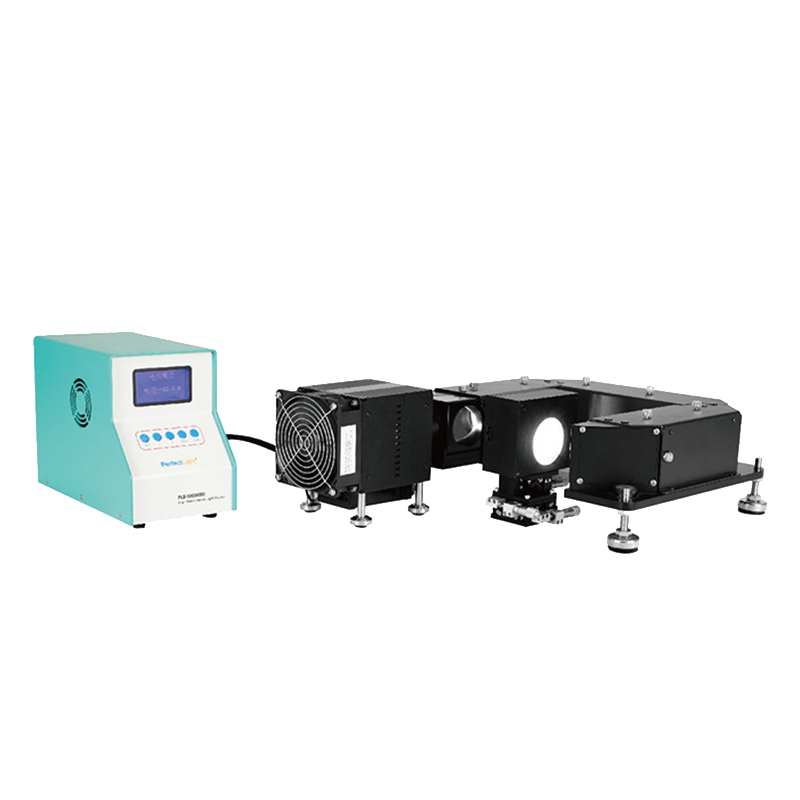
However, as research progresses from milligram-scale laboratory samples to square-meter-scale industrial demonstrations, optical management faces real challenges such as uneven light field distribution and scaling effects. In large-area flat reactors, ensuring that every catalytic site receives consistent spectral components is crucial for successful process scaling. This requires optical systems to be equipped with AM 1.5G solar spectrum correction filters, smoothing out high-energy infrared peaks in the xenon lamp spectrum and ensuring that the irradiance distribution strictly follows international standards. By incorporating digitally feedback-controlled optical arrays and high-stability motorized platforms, researchers can precisely capture the bulk temperature data of catalysts under realistic illumination conditions, thereby providing scientific kinetic parameters for engineering transformation.
Filter technology is leading catalytic science from qualitative observation to multi-dimensional precision control. Whether using bandpass filters to pinpoint excitation wavelengths or employing spectral splitting systems for efficient energy coupling, precise optical components solidify the experimental foundation of clean energy research. It is these hidden precision tools within optical systems that help scientists peel away experimental noise and guide them in the symphony of light, heat, and matter, ultimately seeking the ultimate answers for reshaping the global energy landscape.
Recommended
news