In the scientific pursuit of addressing the energy crisis and achieving "carbon peak and carbon neutrality," photocatalytic water splitting is regarded as a core pathway for realizing "artificial photosynthesis." The fundamental principle involves using semiconductor materials to absorb sunlight, generating reductive electrons and oxidative holes that drive the redox reaction of water molecules, directly converting low-density solar energy into high-energy-density hydrogen (H₂). For researchers, this process involves not only complex charge carrier kinetics but also relies on an evaluation system capable of accurately reflecting the intrinsic activity of the reaction.
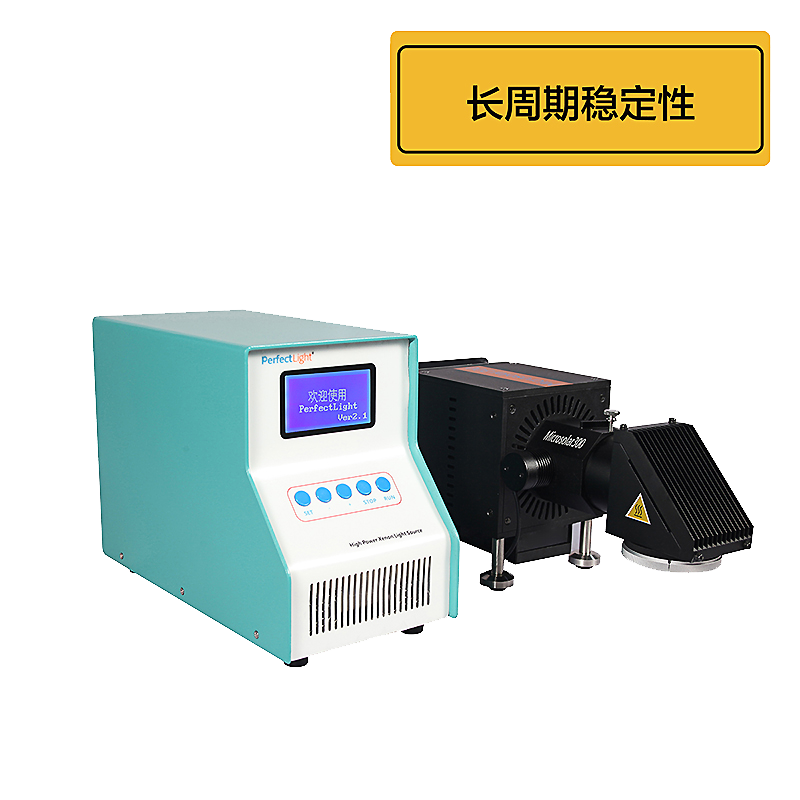
From a physical-chemical perspective, efficient photocatalytic water splitting involves four key steps: photon capture, charge separation and migration, surface redox reactions, and product desorption. In laboratory evaluation, the stability and energy density of the light source are critical physical benchmarks for data reproducibility. The Microsolar 300 Xenon lamp, utilizing ceramic xenon design with core solar simulator technology (TSCS), provides an ideal light field environment for hydrogen production via water splitting. Its built-in precision optical feedback system can monitor and adjust output intensity in real-time, maintaining long-term irradiation instability within ≤±3%. This high level of stability ensures constant light conditions during catalyst stability tests lasting tens of hours, allowing for more accurate analysis of catalyst deactivation mechanisms and conversion efficiency.
However, after the photochemical reaction, accurately capturing and quantitatively analyzing the trace gases produced is another experimental challenge. Since hydrogen (H₂) is highly flammable and easily affected by re-adsorption or air infiltration in closed systems, traditional sampling methods often suffer from significant human error and safety risks. The μGAS1001 Micro Gas Reaction Evaluation System, developed to meet these demands, provides a fully automated online analysis solution. The system integrates an advanced gas circulation module, powered by a passive magnetically driven fan pump, achieving rapid homogenization of H₂ and O₂ within 10 minutes while structurally eliminating the risk of spark-induced hydrogen explosions.
Crucially, the μGAS1001 offers extremely high system airtightness, with a dynamic oxygen leak rate below 0.1 μmol/h, which is essential for calculating the apparent quantum yield (AQY) of complete water splitting and verifying the stoichiometric ratio of products. Its patented sampling valve island allows fully automated online sampling, with a maximum sampling ratio of 88:1. Even for advanced photocatalysts with very low gas production, the standard curve achieves a linear regression R²>0.999. This full-chain engineering support—from "stable light input" to "precise product detection"—enables researchers to avoid tedious manual operations and focus on core scientific issues such as bandgap engineering and heterostructure construction.
Therefore, research on photocatalytic water splitting is transitioning from qualitative observation to quantitative analysis. By integrating highly stable light simulation devices (such as the Microsolar 300) with high-sensitivity automated detection terminals (such as the μGAS1001), researchers can more thoroughly analyze the evolution of photogenerated charges at interfaces, laying a solid data foundation for large-scale solar hydrogen production projects akin to "Hydrogen Farms."
Recommended
news