The efficient abatement of volatile organic compounds (VOCs) is a central focus in the field of environmental remediation. Regarding the question of whether biodegradation can remove VOCs, the answer is affirmative. Biodegradation typically leverages microbial metabolic activity to transform adsorbed or dissolved organic pollutants into carbon and energy sources, ultimately producing CO₂, H₂O, and microbial biomass. When treating biomass degradation and related organic exhaust gases, microbes secrete extracellular enzymes that attack pollutant molecules, breaking them down into harmless small molecules.
However, for researchers with a scientific and engineering background, it is important to recognize the significant limitations of conventional biodegradation technologies in handling industrial VOCs. Biological methods often require long hydraulic retention times and are highly sensitive to fluctuations in inlet concentration, temperature, and pH. When pollutant concentrations are too high or contain biotoxic components, microbial activity can be rapidly inhibited. To address this limitation, PoFelai Technology, based on research from the Institute of Physical Chemistry at the Chinese Academy of Sciences, developed a more engineering-practical “cold incineration” solution.
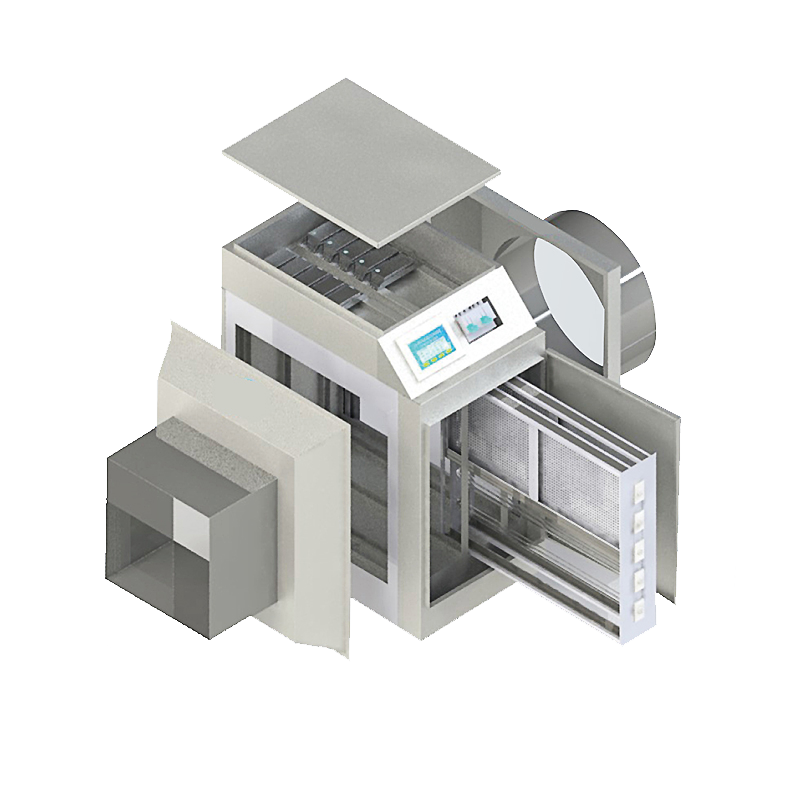
For low-concentration, odorous, and high-risk organic exhaust, the ZKRT-D organic exhaust cold incineration purification device demonstrates outstanding performance. This system does not solely rely on microbial metabolism but employs an innovative adsorption-driven gas-phase advanced oxidation technology, perfectly combining the rapid enrichment capability of adsorption with the deep oxidation power of the UV-Fenton process. Compared to biodegradation, this system can effectively handle high-risk components that are difficult for biological methods, and its core adsorption catalyst features in-situ regeneration, with a service life exceeding two years. Moreover, it operates without producing secondary pollution, achieving complete destruction of VOC molecules.
At the laboratory research stage, a precise research platform is essential to investigate the mechanisms of different degradation pathways, such as gas-phase products from biomass pyrolysis or photothermal synergistic degradation. The PLR-RP series photothermal catalytic reaction evaluation system provides a professional platform for systematically studying gas–solid VOC degradation. This system employs an innovative quartz light-column guiding method to direct the light source straight to the reactor core and features a unique annular-illumination reactor design, increasing the catalyst’s illuminated area from 0.3 cm² in a flat configuration to approximately 20 cm². This design not only improves photon utilization but also greatly enhances mass transfer efficiency at the gas–solid interface, enabling researchers to accurately evaluate the full kinetic process from CO₂ reduction to VOC mineralization under simulated real-world conditions.
While biodegradation offers low-energy advantages in certain scenarios, modern industrial and precision experimental demands favor solutions that combine high-efficiency physical adsorption with advanced oxidation technologies. The cold incineration equipment and high-precision photothermal catalytic evaluation system provide a more controllable, stable, and efficient pathway for VOC abatement. By supporting the full chain from microscopic mechanistic studies to macroscopic engineering applications, VOC management is transitioning from purely biological treatment to advanced multi-field synergistic conversion.
Recommended
news