Research highlight. A 2026 Chemical Engineering Journal paper reports a quasi-two-dimensional g-C3N4/Cs2CuBr4 (CCB) heterostructure for selective photocatalytic CO2-to-CO conversion. The study focuses on how interfacial built-in electric fields influence charge migration and CO2 activation.
In a conventional Type-I heterojunction, photogenerated electrons and holes may accumulate in one semiconductor. Although this can be useful for certain optical processes, it can also limit the retention of strongly reducing electrons needed for CO2 conversion. Interface design is therefore central to balancing charge separation with redox capability.
The authors anchored Cs2CuBr4 nanoclusters in situ onto two-dimensional g-C3N4. The resulting quasi-two-dimensional contact was designed to create a stable interfacial region rather than a simple physical mixture.
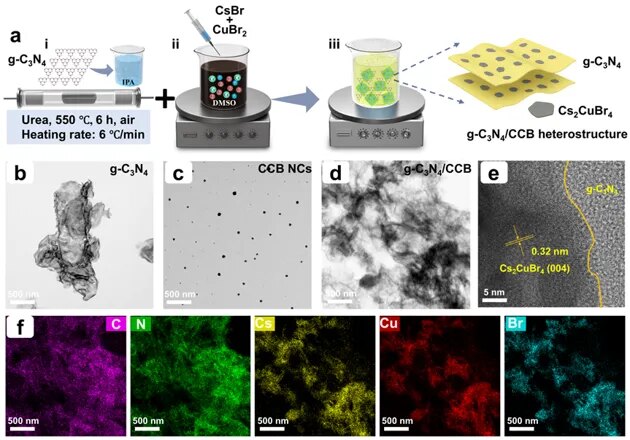
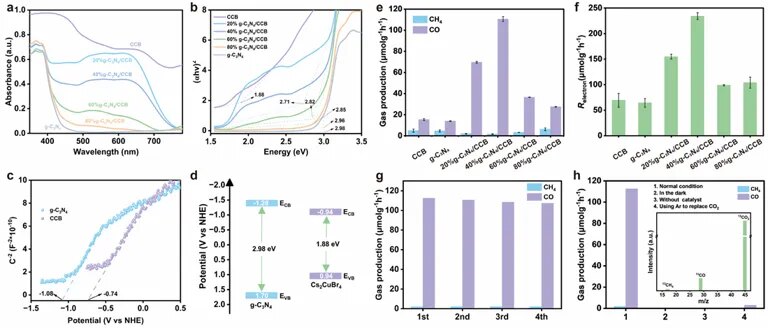
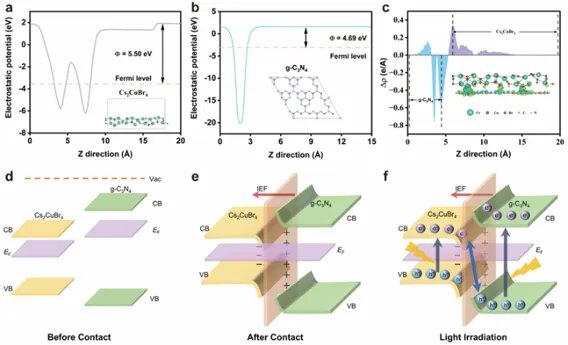
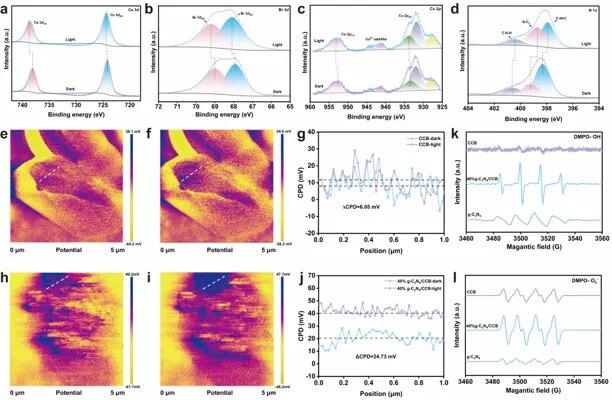
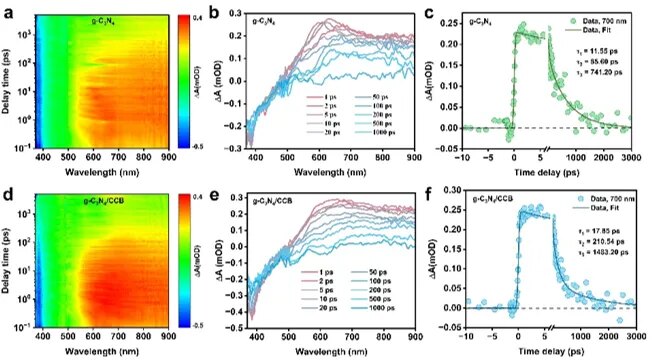
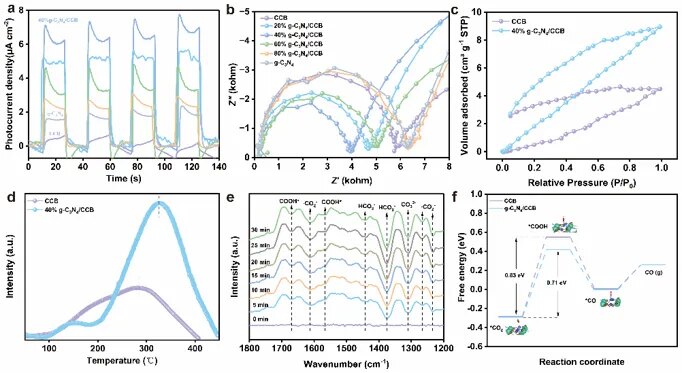
The source describes a non-classical Type-I alignment in which the built-in electric field drives Z-scheme-like charge transfer under illumination. This pathway enriches electrons on g-C3N4, helping retain reduction capability while promoting CO2 adsorption and activation.
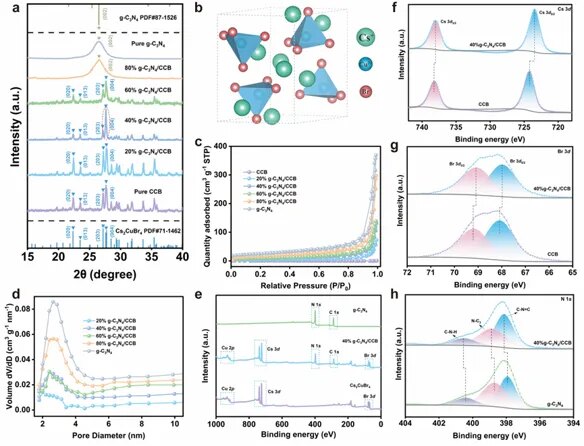
The study combines XRD, BET, XPS, in situ XPS, Kelvin probe force microscopy, ESR, femtosecond transient absorption, photocurrent and impedance measurements with CO2 adsorption, temperature-programmed desorption, DRIFTS and DFT analysis. Together, these methods connect structural interface design with observed catalytic behavior.
The source article reports use of a predecessor of the μGAS1001 micro-gas reaction evaluation system. In research on gaseous products, the light source, reactor, gas handling, sampling sequence, calibration and data processing should be treated as one experimental chain. See photothermal and photocatalytic reaction systems for related system configurations.
L. Dong, Q. Zeng, X. Zhong, et al. Interface-engineered built-in electric fields in g-C3N4/Cs2CuBr4 non-classical Type-I heterostructures for selective CO2-to-CO conversion. Chemical Engineering Journal 2026, 531, 173817. DOI: 10.1016/j.cej.2026.173817.
Sales Email: network@perfectlight.cn