In the grand pursuit of green energy and chemical transformation, photochemical reactions are recognized as a key technology for achieving “low-carbon production” due to their ability to drive high-energy barrier bond cleavage under mild conditions. For readers with a fundamental research background, the core of photochemical reactions lies in the collision between photons and matter, and the efficiency of this process is determined by the quality of the light source. For a long time, xenon lamps simulating sunlight dominated laboratories. However, with the rise of precision medicine, the Materials Genome Initiative, and continuous-flow chemistry, a more precise and flexible energy source—photochemical experiment LED lamps—has rapidly become the “scalpel” in the hands of researchers.
From the perspective of underlying physical mechanisms, the photocatalytic process involves photon capture, excitation of photogenerated carriers (electrons and holes), bulk phase separation, and interfacial redox reactions. When monochromatic light strikes the surface of a semiconductor material, photons with energy exceeding the bandgap induce electron transitions. Unlike xenon lamps, which provide a “broad and full” spectrum output, LED sources excel in narrow-band spectral emission. Typically, the central wavelength of an LED is highly accurate, with a full-width at half-maximum (FWHM) of only 15–20 nm. This feature allows researchers to precisely control excitation energy, effectively avoiding thermal interference caused by long-wave infrared light, and to study the quantum dynamics of reactions under isothermal conditions more purely. For experiments requiring calculation of the apparent quantum yield (AQY), this monochromaticity is significantly superior to traditional light sources combined with filters, reducing errors caused by spectral overlap.
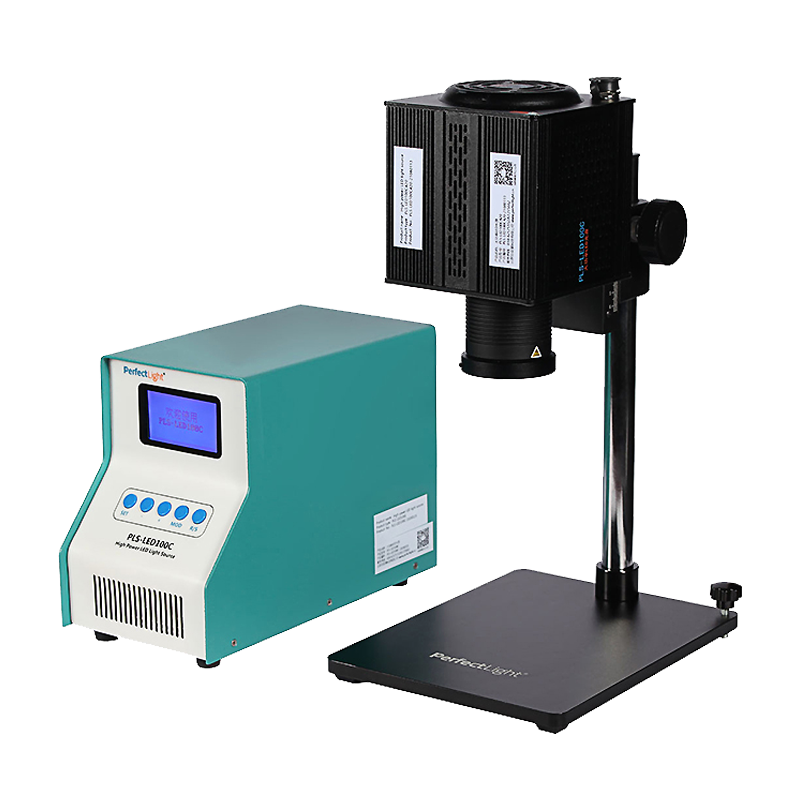
In real experimental environments, the long lifespan and high stability of LED light sources provide unmatched engineering advantages. During long-term stability tests lasting tens or even hundreds of hours, power fluctuations in the light source can obscure the true deactivation mechanisms of catalysts. The PLS-LED 100C high-power LED light source was specifically designed as a professional evaluation tool to address this challenge. This light source uses advanced arrayed LED chips, with periodic instability strictly controlled within ±1%, and a lifespan exceeding 10,000 hours, far surpassing traditional gas discharge lamps. More importantly, it offers continuous, pulsed, and stepwise irradiation modes, allowing researchers to study transient charge transport characteristics by adjusting the duty cycle. This digital power management mode, combined with a highly stable adjustable mount, provides a solid physical benchmark for the precise characterization of photosensitive materials in material science.
Beyond single-point excitation, modern research emphasizes efficiency in high-throughput screening. In photochemical synthesis methodology studies, catalyst screening, reaction condition optimization, and substrate expansion often involve hundreds or thousands of experimental comparisons. Using traditional single reactors, the time cost becomes a bottleneck. The PCX-50C Discover multi-channel photocatalytic reaction system perfectly addresses this issue. This system integrates nine LED light sources, covering multiple bands from ultraviolet to infrared (365 nm to 760 nm), and supports deep customization of wavelength combinations. On this integrated platform, researchers can perform multiple parallel experiments simultaneously. Through microcomputer chip and mechanical linkage coordination, each reaction position maintains consistent magnetic stirring speed and illumination intensity. This design not only avoids errors caused by uneven output from different emitters but also precisely controls reaction temperature via an integrated water-cooling system, ensuring high enantioselectivity in temperature-sensitive asymmetric catalysis, greatly accelerating the development of pharmaceutical molecule synthesis.
Of course, the application of photochemical experiment LED lamps is not limited to mechanistic studies in small glass vials. As research scales toward pilot or even production levels, flexible LED light sources demonstrate powerful spatial adaptability. Whether enhancing mass transfer using Taylor flow in microchannel reactors or verifying solar-to-hydrogen conversion efficiency (STH) in square-meter flat-panel reactors, LED technology, with its cold light source nature and tunable wavelength, resolves common issues of local overheating and light efficiency loss in large-scale equipment. Although xenon lamps still have a natural advantage in full-spectrum AM 1.5G simulation, with the continuous iteration of multi-band LED array technology, LED sources are gradually achieving a perfect balance between full-spectrum simulation and precise energy delivery.
In summary, photochemical experiment LED lamps are leading photochemical research from “empirical exploration” to “rational design.” By introducing evaluation platforms such as the PLS-LED 100C and PCX-50C, which feature high stability, digital feedback, and high-throughput capabilities, scientists can penetrate the fog of physical field fluctuations and reach the essence of chemical bond cleavage and reformation. In this scientific game of chasing and harnessing light, every precisely controlled beam of monochromatic light represents a definitive step toward a clean energy and green fine chemical future. With continuous innovation in photoelectric conversion technology, these “cold light sources” not only illuminate laboratory reaction vessels but also lay a robust scientific foundation for reshaping industrial landscapes for humanity.
Recommended
news