In humanity’s grand pursuit of a zero-carbon future, artificial photosynthesis—using solar energy to drive chemical transformations—is regarded as the “holy grail” for reshaping the global energy landscape. For researchers on the front lines, replicating a constant natural light field within the confines of a laboratory requires not only a deep understanding of semiconductor physics but also high-quality simulated light sources. Domestic photocatalytic xenon lamps, as cornerstone instruments in this field, not only deliver spectral outputs that mimic sunlight but also precisely control photon energy delivery, providing a physical foundation for the reliability of every kinetic curve.
From a fundamental scientific perspective, photocatalytic reactions begin with the absorption of photons by the material. When the energy of incident photons exceeds the bandgap of a semiconductor, valence band electrons are excited to the conduction band, forming photogenerated charge carriers (electrons and holes). These transient carriers then migrate to the surface to drive hydrogen evolution or carbon dioxide reduction reactions. Xenon lamps stand out among light sources because their internal high-pressure xenon gas discharge produces a continuous spectrum that closely matches natural sunlight across 320 nm to 2500 nm. This broad-spectrum characteristic allows researchers to observe the intrinsic response of materials across the entire wavelength range, enabling precise band structure design.
However, obtaining highly reliable data in real experimental research is no simple task. Minor fluctuations in photon output—i.e., irradiance instability—often mask catalyst deactivation mechanisms or variations in quantum yield. To address this challenge, the Microsolar 300 xenon lamp demonstrates the advanced digital management capabilities of domestic instruments. The system applies cutting-edge solar simulator core technology (TSCS) and features a precision optical feedback module. It continuously monitors light output and automatically compensates power, keeping long-term irradiance instability within ±3% over 8 hours. For researchers performing long-term water splitting stability tests, this high stability ensures that each set of H₂ or O₂ production data is free from light source decay interference, guaranteeing the comparability of experimental results.
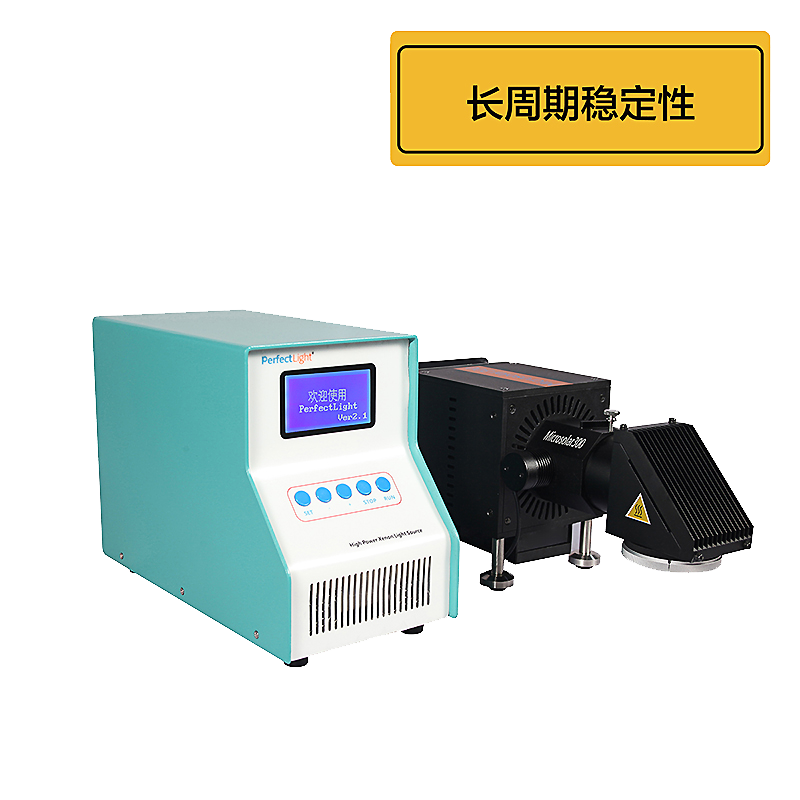
Beyond stability, uniformity of the light field is another critical criterion for evaluating experimental system quality. When calculating apparent quantum yield (AQY) or solar-to-hydrogen (STH) conversion efficiency, the total number of incident photons must be highly precise. If the light spot contains central hotspots or edge decay, the calculated efficiency will show significant statistical deviations. To meet the needs of large-area film testing or photovoltaic device evaluation, the CHF-XM series xenon lamp provides a flexible engineering solution. This series features a modular design that allows free switching between point source, collimated beam, and fiber output modes. Its collimated beam mode uses a specialized optical shaping cylinder to achieve uniform light spots similar to a solar simulator, with minimal divergence, effectively addressing experimental reproducibility issues caused by uneven light intensity distribution.
It is worth noting that to make experimental conditions closer to real-world scenarios, constructing a standardized AM 1.5G spectral environment has become a consensus in the international academic community. Since xenon lamps exhibit several high-energy peaks in the infrared region, domestic manufacturers optimize the spectrum by incorporating solar spectrum correction filters and full-reflection elements. Additionally, engineering challenges extend to safety and thermal management. Advanced domestic xenon lamps, such as the PLS-SXE300E, feature non-metallic housings to increase insulation resistance, patented axial suction cooling structures, and fan failure self-diagnosis functions, ensuring long-term reliability under high-load operation.
Looking ahead, as photoelectrochemical (PEC) research evolves toward multi-field coupling and engineering demonstrations, domestic photocatalytic xenon lamps are transforming from a simple “illumination” function into evaluation platforms integrating light intensity monitoring, wavelength control, and intelligent management. From capturing carrier dynamics on the microsecond scale to performance calculations for square-meter-scale flat reactors, each technical upgrade in precision research equipment reinforces the foundation for green hydrogen and artificial photosynthesis. On this long path of chasing light, these “laboratory artificial suns” crafted with Chinese ingenuity are cutting through the fog of physical interference, guiding researchers to find definitive answers in the symphony of light and matter.
Recommended
news