In humanity’s grand pursuit of energy independence and low-carbon transformation, hydrogen, with its extremely high energy density and zero terminal emissions, is widely recognized as a core medium connecting green energy with sustainable industry. However, traditional green hydrogen production often faces a disconnection between generation, storage, and transportation, leading to cumulative efficiency losses. Against this backdrop, the concept of **integrated water splitting and hydrogen storage** has emerged—not only as an in-depth exploration of photochemical mechanisms in laboratories but also as a paradigm shift in energy lifecycle management within engineering. It aims to directly convert solar energy into chemical energy and store it in situ in a stable form, sketching a vision of direct and efficient “liquid sunlight.”
From a fundamental scientific perspective, this process is essentially a highly integrated form of **artificial photosynthesis**. When sunlight is absorbed by a **semiconductor** material, the resulting **photo-generated charge carriers** must escape recombination “traps” within nanoseconds and migrate to active sites on the material surface. To achieve system integration, researchers often tune the **bandgap** of the semiconductor so that it can capture a broad spectrum of visible light while providing sufficient redox potential to drive water splitting. For readers with a research background, the core challenge lies in balancing **quantum efficiency** with long-term system stability. In such an integrated architecture, the generated hydrogen often needs to immediately couple with hydrogen storage media (e.g., coordination hydrides or liquid organic carriers), imposing stringent kinetic matching requirements at the reaction interface.
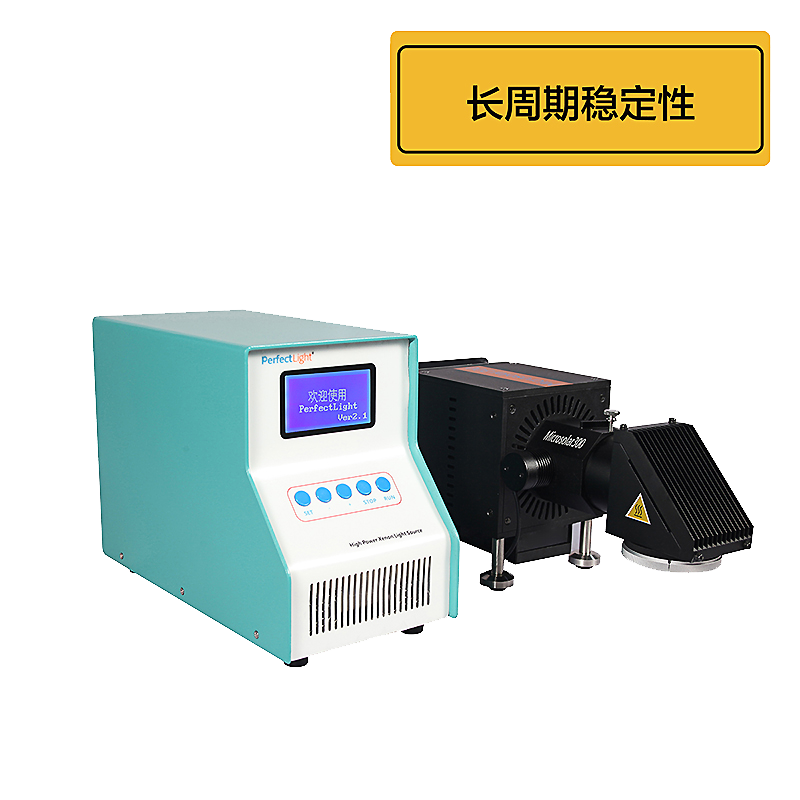
In conducting these advanced mechanistic studies, maintaining a stable experimental environment is critical for obtaining reliable scientific conclusions. The water splitting reaction is extremely sensitive to fluctuations in incident light intensity, and even minor spectral drifts can interfere with assessments of the intrinsic activity of the catalyst. In laboratory contexts, the **Microsolar 300 xenon lamp** demonstrates its professional depth as a core research instrument. Utilizing advanced solar simulator core technology (TSCS) and digital power management, it strictly controls long-term irradiation instability within ±3% over 8 hours. Such high-precision light field control allows researchers to eliminate the influence of external light fluctuations and focus on investigating the coupling logic of charge transfer and energy conversion within integrated systems under varying irradiance. Only under such stable physical conditions can **Faradaic efficiency** calculations achieve cross-laboratory comparability and credibility.
Once microscopic electron transitions are converted into macroscopically measurable chemical products, accurately quantifying hydrogen generation and confirming the 2:1 theoretical **stoichiometric ratio** becomes a key technical threshold for evaluating the performance of integrated systems. Since integrated devices often include complex hydrogen storage components, the trace gases produced are highly susceptible to adsorption on internal tubing walls or contamination from ambient oxygen. To address this challenge, the **Labsolar-IIIAG online photocatalytic analysis system** provides a fully glass, low-adsorption operational environment. Its physical structure eliminates chemical adsorption of hydrogen molecules on metal surfaces or potential electrolysis interference. Coupled with its patented magnetic circulation pump technology, the system ensures that gases reach kinetic equilibrium within 10 minutes. This rigorous tracking of “every molecule” allows researchers to accurately determine the system’s **apparent quantum yield** (AQY), providing a solid material foundation for precise calculation of **solar-to-hydrogen conversion efficiency** (STH).
Beyond precise laboratory characterization, the ultimate goal of integrated water splitting and hydrogen storage is engineering-scale application. In recent years, the academic community has actively promoted the **Hydrogen Farm** strategy, which embodies the integration concept at large scale. It requires shifting focus from milligram-scale powder systems to square-meter-scale planar reaction arrays and incorporating solar tracking to maximize light utilization. In this transformation, engineering challenges shift from solely improving quantum efficiency to optimizing system mass transfer efficiency, in situ product separation, and long-term photostability. By accounting for energy losses across the entire chain within a unified physical framework, the gap between laboratory discovery and industrial demonstration is gradually narrowed.
In summary, integrated water splitting and hydrogen storage represents not only a cross-disciplinary convergence in physical chemistry but also a key to a zero-carbon future. From precise band structure engineering to standardized performance evaluation with advanced instrumentation, and onward to outdoor-scale technical implementation, each breakthrough relies on rigorous adherence to scientific methodology. By integrating evaluation platforms such as Microsolar 300 and Labsolar-IIIAG, which provide digital feedback and high-precision measurement capabilities, researchers can strip away experimental noise and reach the essence of energy conversion. In the journey of reshaping the future energy landscape, this extreme calibration of microscopic efficiency and meticulous system engineering is the core driving force pushing green hydrogen technology toward industrial-scale realization.
Recommended
news