In the grand narrative of humanity’s response to global warming and the construction of a low-carbon sustainable development system, hydrogen energy, with its extremely high energy density and zero end-use emissions, is recognized as the ultimate link connecting renewable energy sources to end-use applications. Currently, the vast majority of hydrogen is still derived from fossil fuel reforming ("gray hydrogen"), a process accompanied by significant carbon emissions. In contrast, photocatalytic water splitting for hydrogen production, inspired by the photosynthesis of green plants in nature, can directly capture dispersed solar energy and convert it into storable chemical bond energy. This "green hydrogen" production pathway, with its mild reaction conditions, independence from large-scale power grids, and theoretically high conversion limits, shows extremely broad prospects for water splitting hydrogen applications and is vividly referred to by scientists as the "Liquid Sunshine" initiative.
From the perspective of fundamental research, the water splitting reaction is a multi-scale complex process involving photon capture, charge carrier separation, and surface redox reactions. Over the past decades, global researchers have achieved remarkable progress in developing high-efficiency semiconductor materials, optimizing band structures, and regulating interfacial dynamics. However, the quantum sparks released by milligram-scale catalysts in the laboratory must bridge the vast gap from "material development" to "engineering design" in order to be scaled up for practical energy use. For scientifically literate readers, understanding this transition centers on addressing the so-called scale-up effect—catalytic systems that perform excellently at a small lab scale often experience dramatic efficiency drops when expanded by tens of thousands of times due to uneven illumination, mass transfer limitations, and local overheating.
To advance green hydrogen technology toward industrialization, the academic community has proposed innovative strategies such as the "Hydrogen Farm." This strategy draws inspiration from agricultural logic by deploying granular catalysts over large areas and operating them under natural sunlight, thereby achieving significant improvements in solar-to-hydrogen (STH) conversion efficiency. In this process, the practical realization of water splitting hydrogen applications relies not only on the emergence of new catalysts but also on the evolution of reactor configurations. Compared with traditional stirred-tank reactors, flat-plate reactors offer larger light-receiving areas, more uniform catalyst illumination, and superior reactant mass transfer efficiency, making them the core physical carriers for large-scale outdoor deployment. Through optimized configurations, researchers can ensure that every photon in the system maximally drives chemical bond cleavage and reconstruction.
When discussing specific scale-up validation, the engineering focus is on achieving a smooth transition from small 10×10 cm² laboratory slices to square-meter or even hundred-square-meter arrays. In this context, the PLR-SPRG production-grade flat-plate photochemical reactor demonstrates its professional depth as an engineering evaluation platform. This system does not simply scale up reactor volume proportionally but adopts a modular integration logic, using a 0.5 m² light-receiving unit as the base and flexibly connecting units in series or parallel to achieve large-area production. This design fully considers the complexities of industrial applications, and its unique flow-stirring layer ensures rapid mixing of the reaction solution within the plate space, reducing dead volume and significantly improving mass transfer efficiency. From a scientific rigor standpoint, the device is equipped with a complete PLC-integrated control system capable of real-time monitoring of key parameters such as solution pH, redox potential, flow rate, and solar irradiance, providing a solid data foundation for safe and controllable large-scale hydrogen production.
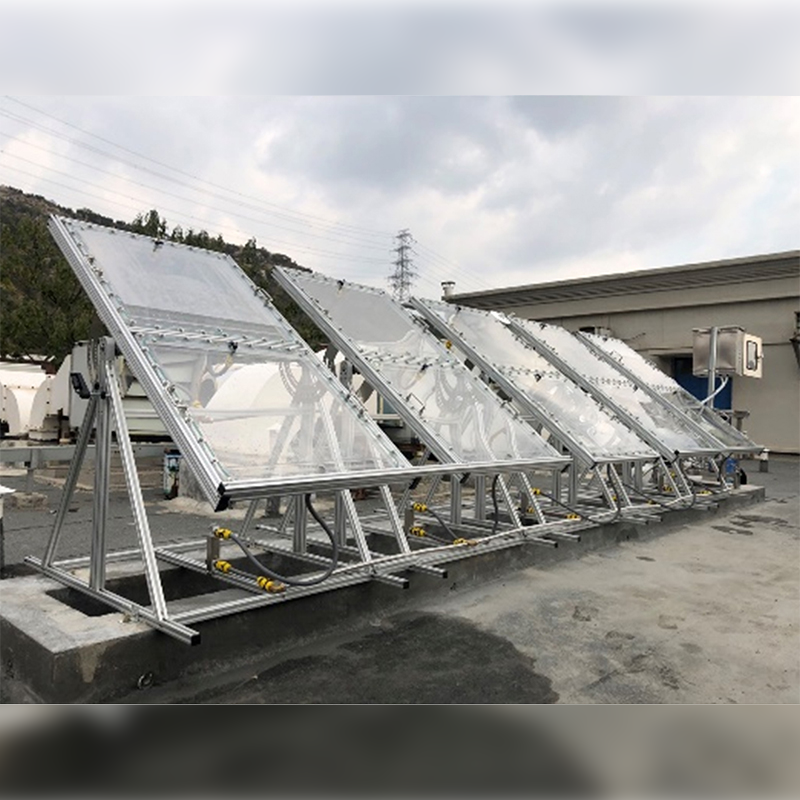
Beyond structural optimization, long-term stability and Faradaic efficiency calculations are essential metrics for assessing whether water splitting hydrogen applications can be commercialized. In outdoor, open environments, the reaction system must withstand fluctuations in temperature and humidity, dust coverage, and extreme wind conditions. Modern flat-plate reactors incorporate long-life, corrosion-resistant sealing structures, achieving minimal relative pressure variations and effectively preventing air nitrogen and oxygen from penetrating. Through such high-reliability physical field management, researchers can precisely quantify H₂ and O₂ production per square centimeter of catalytic surface under natural sunlight, thereby evaluating the catalyst’s resistance to photodegradation over long-term operation and its economic viability in real-world production.
Looking ahead, the application landscape of water splitting hydrogen production is expanding in diverse directions. Beyond pure water splitting, coupled applications such as wastewater treatment, direct seawater hydrogen production, and CO₂ gas-phase reduction are gaining increasing attention. These cutting-edge directions demand higher compatibility and scalability from evaluation equipment. By integrating digital techniques such as automated sampling and in situ spectroscopic analysis, researchers can cut through physical interference and probe the essence of energy conversion. The paradigm shift from empirical exploration to rational design is precisely what drives green hydrogen technology from laboratory-scale innovation to large-scale "Hydrogen Farms," paving the way for a sustainable, sunlight-powered energy future.
Recommended
news