In the quest to reshape the global energy landscape, artificial photosynthesis driven by solar energy is regarded as a core pathway toward a carbon-neutral future. For researchers at the forefront of science, the essence of photochemical reactions lies in the capture and conversion of photons by semiconductor materials, meaning that photons are not merely background energy but key “reagents” participating in the reaction. However, in real experimental contexts, the energy of light is far more complex than the simple brightness perceived by the naked eye. Without accurately answering “how much energy actually enters the reaction system,” all kinetic data and efficiency calculations risk being built on sand, which is why light power meters occupy a central role in precision scientific evaluation systems.
From a fundamental scientific perspective, the credibility of photocatalytic experiments relies on the “absolute constancy” and “traceability” of energy input. In practice, researchers often encounter a common issue: even when the same light source current is set, the actual irradiance on the illuminated surface can deviate significantly due to natural aging of xenon lamp bulbs, slight shifts in collimating lenses along the optical path, or changes in the transmittance of reactor optical windows over prolonged use. Ignoring these “minor fluctuations” can result in hydrogen evolution rates or pollutant degradation rates that cannot be normalized across different batches of experiments. Therefore, measuring light intensity with a light power meter before each photocatalytic experiment has become a standard step to ensure reproducibility and accuracy.
As research paradigms advance toward photothermal catalysis and multi-field coupling, experimental scenarios impose even stricter engineering demands on energy density quantification. To drive high-energy-barrier reactions such as methane reforming or CO₂ hydrogenation, researchers often use concentration techniques to achieve energy densities far exceeding standard solar irradiation. In such extreme physical fields, conventional low-light sensors are prone to saturation or overheating and may fail. Here, the PL-MW2000 high-intensity light power meter demonstrates its technical depth as a professional evaluation tool. Specifically designed for high-intensity light sources, this device offers a range of up to 20 W and features a unique removable optical filter design. When energy exceeds 5 W, researchers can install the filter to precisely calibrate strong light output from sources such as the PLS-SME400E H1 xenon lamp, allowing in-depth analysis of the synergistic mechanisms between photothermal effects and photochemical excitation.
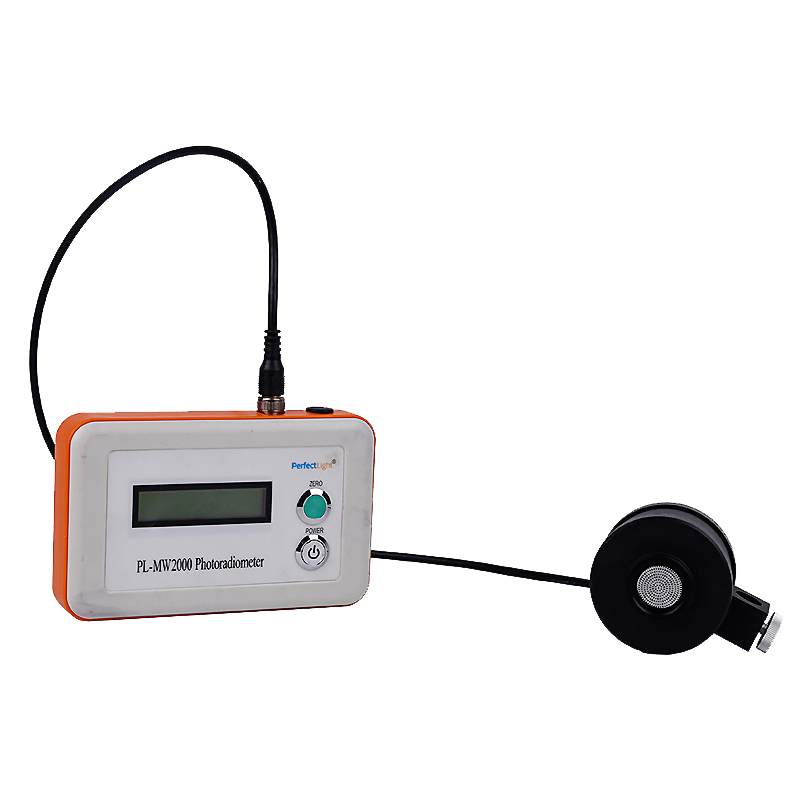
Beyond measuring absolute intensity, the uniformity of the light field is another critical benchmark for experimental credibility. In real laboratory research, light spots from xenon lamps or LED arrays typically exhibit a Gaussian distribution, with strong intensity at the center and rapid decay at the edges. Using the central point intensity to represent the average intensity across the illuminated surface inevitably introduces significant errors when calculating apparent quantum yield (AQY) or incident photon-to-electron conversion efficiency (IPCE). To address this, researchers often adopt standardized multi-point measurement protocols, measuring multiple points at the center and edges to calculate the average light power density over the reaction surface. This meticulous attention to optical field details, combined with sensors featuring cosine correction for oblique incidence, minimizes errors from stray light and ensures precise evaluation of material performance.
During routine screening of visible-light-responsive materials, equipment portability and multi-band compatibility also affect the timeliness of research output. For instance, when evaluating the photocatalytic activity of modified graphitic carbon nitride (g-C₃N₄) or novel metal-organic frameworks (MOFs), researchers typically focus on irradiance in the 400–1000 nm wavelength range. In such cases, the FZ-A domestic irradiance meter has proven to be a reliable laboratory tool due to its portable design and automatic range-switching capability. Equipped with high-precision, low-power digital chips and rigorously spectrally calibrated detectors, it is suitable for measuring the visible spectrum close to AM 1.5G sunlight. This rapid-response, highly linear evaluation terminal helps researchers quickly eliminate environmental noise and directly probe the intrinsic quantum conversion efficiency of catalysts during complex experimental workflows.
Looking ahead, as photochemical research scales from pilot studies to industrial demonstrations, the role of light power meters is evolving from simple “readout devices” to core modules within integrated monitoring systems. In large-area flat reactors or continuous-flow photoelectrochemical testing setups, light power meters are not only used for pre- and post-experiment calibration but also integrated into automated feedback loops. By continuously monitoring light intensity fluctuations and automatically adjusting power supply or stage height, the system maintains a stable optical-physical field over extended periods. This synergy between precise instrumentation and scientific methodology enables researchers to cut through physical interference and access the microscopic essence of molecular bond breakage and formation. In the scientific quest for “liquid sunlight,” these hidden optical tools are steadily laying the foundational stones for reshaping human energy and environmental harmony.
Recommended
news