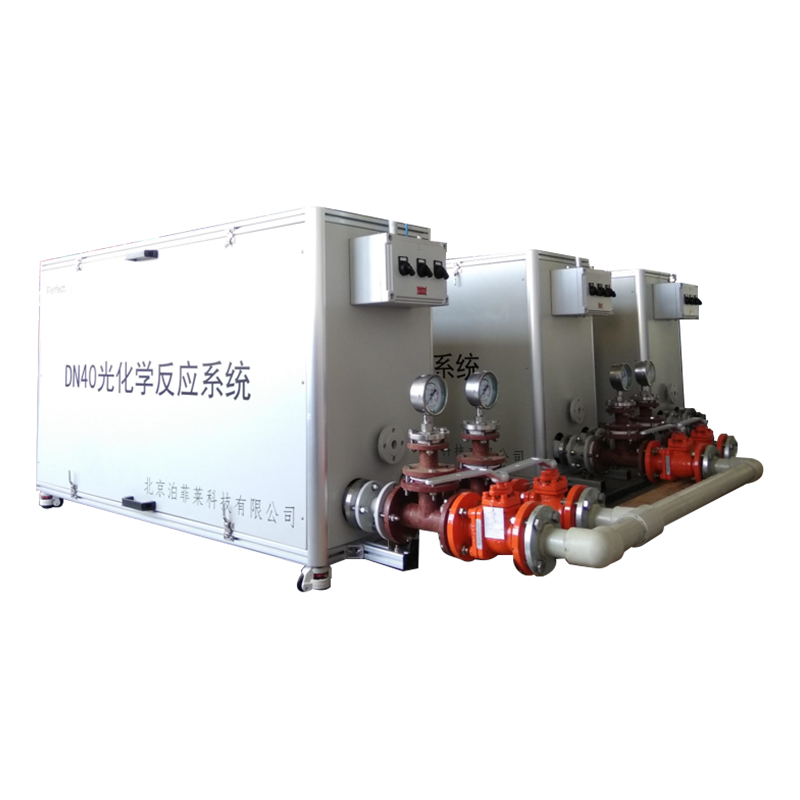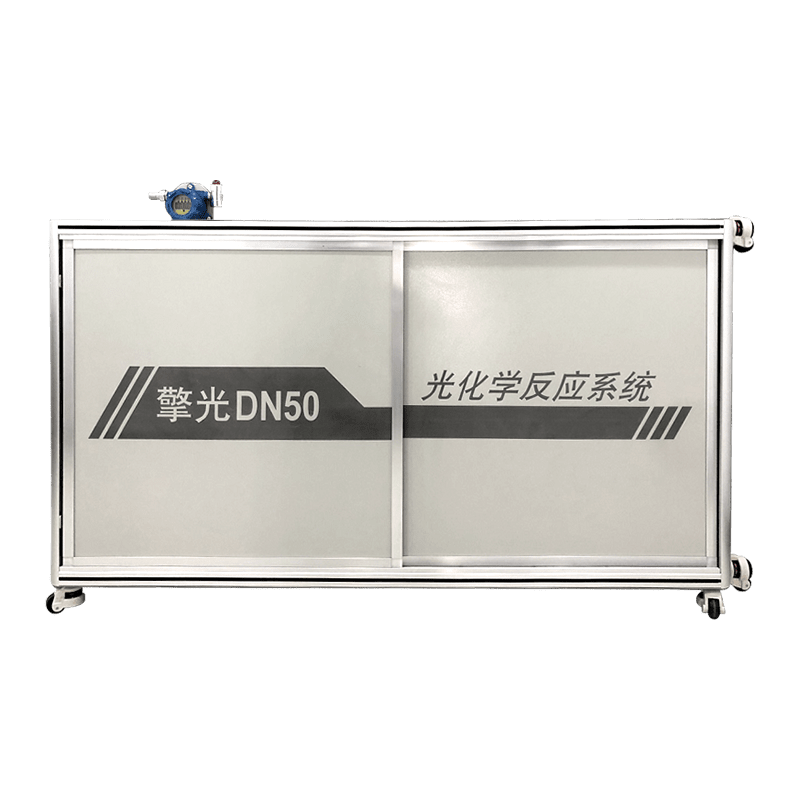


The system is divided into two main parts: the reaction system main body and the power distribution control cabinet. A flow reactor under irradiation is constructed, which, in combination with peripheral supporting equipment, enables the application of continuous photochemical synthesis. The system can be used for pilot-scale or small-batch production of various photochemical reactions, such as pharmaceutical molecular synthesis and organic synthesis.
The reaction system main body includes: dual-sided DN50 reaction pipelines, high-power LED light sources, various interfaces (such as gas inlet, material inlet, viewing window, temperature probe interface, alarm interface, etc.), explosion-proof distribution boxes, and protective enclosures. The power distribution control cabinet is equipped with six adjustable power supplies and is automatically controlled via a touch-screen central PLC for system status monitoring, safety warnings, and handling.
• Structural Scale: Balancing Light Penetration and Processing Throughput
The Qingguang DN50 photochemical reaction system adopts an engineering-validated 50 mm tube diameter, effectively balancing “light penetration depth” and “single-tube throughput.” Combined with a 1.1 m standard reaction section and a dual-row reaction volume of 14 L, this design avoids the system complexity caused by excessive parallelization in microchannel scale-up, while ensuring effective light coverage of the reaction zone, providing a reliable physical foundation for ton-scale mass production.
• Enhanced Mixing: Breaking Laminar Flow to Achieve Uniform Mass Transfer
In industrial continuous-flow processes, the mixing state of fluids directly determines reaction selectivity. The Qingguang DN50 photochemical reaction system integrates enhanced mixing elements inside the reaction tube, abandoning the traditional empty-tube flow structure. This design continuously disrupts laminar flow boundaries during operation, generating intense radial turbulence. Whether in gas–liquid or liquid–liquid systems, it ensures thorough mixing and surface renewal of materials within the tube, guaranteeing uniform light exposure for each unit of material and thereby ensuring consistency in product quality.
• Energy Supply: High Photon Flux Matched to Industrial Capacity
To meet the requirements of industrial production for space–time yield, the system is equipped with a 7.5 kW high-power LED light source array (blue light / custom wavelengths). This high-power-density light field design is intended to provide sufficient effective photon flux. Even under high-flow operating conditions, the reaction system can obtain adequate energy excitation within a short residence time. This means that enterprises do not need to sacrifice capacity to accommodate light-source intensity, thereby achieving truly scalable production.
| Technical Parameters | |||
| Reaction Mode | Tubular Reactor | Continuous Flow or Semi-Batch | |
| Light Source Wavelength | 365 ~ 760 nm | Multiple wavelengths available | |
| Light Source Type | Flexible LED Light Source | Long service life | |
| Unit Power | 7.5 kW | Adjustable optical power | |
| Temperature Control Range | None | Suitable for low-temperature / ambient reactions | |
| Processing Throughput | 14 L × 2 | Meets different residence-time requirements | |
| Reaction Type | Homogeneous liquid–liquid / liquid–solid reactions | ||
| Process Intensification | Built-in Mixer | Enhanced mass and heat transfer | |
| Reaction Tube Material | Glass / Quartz | Customized according to reaction type | |
| Liquid Flow Rate | 82.5 L/min | Maximum flow rate (adjustable per reaction) | |
| Overall Dimensions | 2245 mm × 580 mm × 1235 mm | ||
| Applicable Reactions | UV-light-initiated substrate radical chain reactions, visible-light-activated catalyst-initiated radical reactions, and reactions under simulated sunlight | ||
In the retrofit of a ton-scale production line at a listed pharmaceutical company in Zhejiang, the Qingguang DN50 photochemical reaction system successfully broke through the bottlenecks of the customer’s original process in terms of conversion (approximately 80%) and selectivity (approximately 70%). After the technical upgrade, the system achieved a conversion rate increase to 92% and selectivity improvement to 80%, while significantly reducing initiator usage and realizing stable continuous operation with a daily throughput of 3 tons. This fully demonstrates the mature value of continuous-flow photochemistry in cost reduction, efficiency enhancement, and large-scale production.