On humanity’s journey to reshape the global energy landscape, carbon dioxide is not only a greenhouse gas driving climate change but also regarded by scientists as a vast, “zero-cost” carbon resource. If this CO₂ can be reconverted using the inexhaustible energy of sunlight into methane, methanol, or even higher-value multi-carbon hydrocarbons, it is akin to performing a modern form of alchemy. The underlying logic of this waste-to-fuel transformation is currently a hotspot in energy chemistry: photocatalytic CO₂ reduction. For readers with a basic scientific background, the appeal of this process lies in its seamless integration of semiconductor physics, surface chemistry, and engineering thermodynamics, yet achieving high conversion efficiency still requires overcoming substantial physical barriers.
From a microscopic scientific perspective, CO₂ molecules are thermodynamically highly stable, with C=O bond energies reaching approximately 750 kJ/mol. Inducing bond cleavage under ambient conditions requires extremely high excitation energy. Photocatalysis leverages semiconductor materials to capture photons and generate high-energy electrons, providing the driving force for this reduction process. However, in practical laboratory research, obtaining reliable experimental data is challenging. A primary consideration is the choice of reaction phase: should one adopt a traditional liquid-phase suspension system, or a gas-solid reaction mode with greater industrial potential? In liquid-phase systems, CO₂ solubility in water is extremely low, and water molecules often compete for photogenerated electrons, triggering hydrogen evolution side reactions and reducing product selectivity. In contrast, gas-solid reactions significantly enhance the supply rate of reactant molecules and reduce the high costs associated with catalyst recovery.
To achieve efficient conversion at the gas-solid interface, the temporal and spatial distribution of the reactant gas becomes critical for determining yield. In many early laboratory setups, limited light penetration and “short-circuiting” of the reactant gas over the catalyst surface result in poor matching between catalyst adsorption capacity and photon utilization. Addressing this engineering challenge, the PLC-GDHC I gas-diffusion multiphase continuous catalytic reaction platform offers a highly instructive solution. The system incorporates a porous hydrophobic gas diffusion layer, similar to those used in fuel cells, creating turbulent flow that allows CO₂ and water vapor mixtures to penetrate the catalyst layer like acupuncture needles, achieving full contact at the gas-solid heterogeneous interface. Through external circulation, this design not only enables timely desorption of reaction products from active sites but also allows unreacted gases to repeatedly cycle, greatly enhancing adsorption-diffusion-transfer efficiency at the microscale.
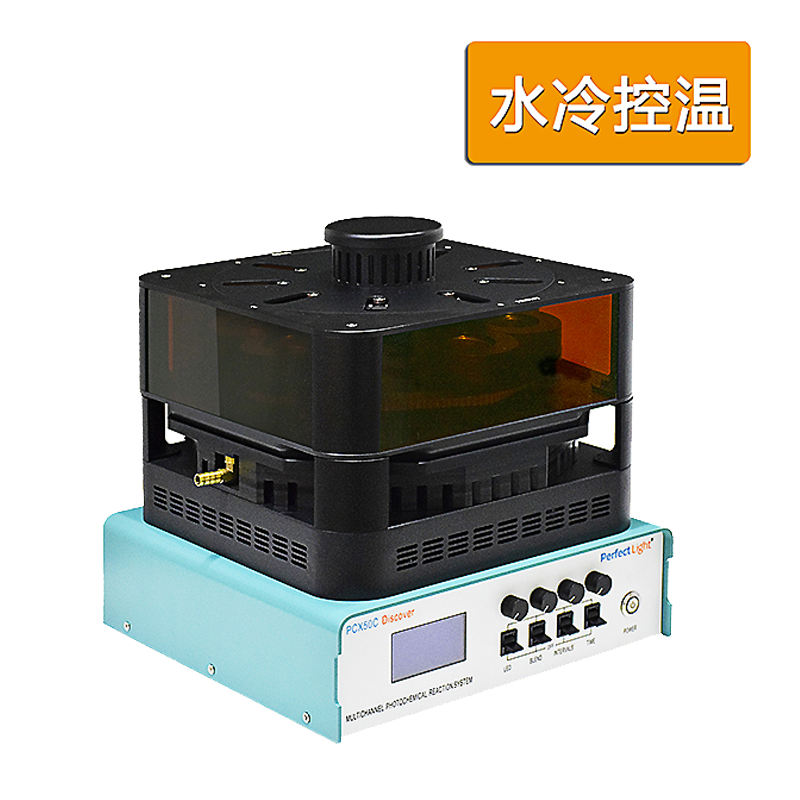
Beyond the precise construction of physical fields, evaluating the intrinsic chemical activity of catalysts is another resource-intensive “marathon.” When developing new metal-organic frameworks (MOFs) or heterojunction materials, researchers often screen dozens of compositions and compare the effects of different excitation wavelengths and gas partial pressures on product selectivity. Using traditional single-sample reaction modes makes the development cycle almost unmanageable. In this context, the PCX-50C Discover multi-channel photocatalytic reaction system becomes a key tool for improving research efficiency. The system integrates nine high-power LED light sources, supporting precise wavelength customization from UV to near-infrared, and employs microcomputer-driven mechanical linkage to ensure uniform stirring speed, illumination intensity, and condensation temperature control across all reaction positions. This highly integrated evaluation platform allows researchers to rapidly capture the “action spectrum” of different catalyst systems within a single experimental cycle, filtering out environmental noise and directly probing molecular-level energy conversion efficiency.
As research progresses to pilot-scale upscaling, multi-field coupling technologies are increasingly employed to enhance conversion rates. Scientists have found that introducing moderate thermal energy or electric fields during illumination can significantly improve intermediate desorption kinetics on catalyst surfaces, and even promote the formation of higher-value C2+ products. Nevertheless, scale-up effects, including uneven temperature distribution and pressure fluctuations, remain key considerations when moving from lab results to square-meter demonstration reactors. Ideal results obtained on small devices often differ significantly from large-scale production under identical operating conditions, highlighting the need to optimize mass and heat transfer and ensure stability in large-area catalyst loading. By incorporating intelligent digital feedback control systems that monitor pH, irradiance, and bulk temperature in real time, researchers are gradually establishing a traceable evaluation standard.
Looking ahead, photocatalytic CO₂ conversion is transitioning from a single “product-oriented” focus to a fully “energy-efficiency-oriented” paradigm. Whether employing microchannel technology to overcome light path loss or using spectral coupling to maximize energy utilization, each advancement in precision research equipment strengthens the experimental foundation of artificial photosynthesis. In this long pursuit of “liquid sunlight,” it is these sophisticated laboratory instruments that filter out experimental noise and guide researchers to uncover the scientific truths of restructuring the global energy landscape. As conversion efficiencies continue to rise, CO₂ will ultimately shift from a persistent greenhouse menace to a valuable resource driving the green industries of the future.
Recommended
news