In the scientific journey of converting solar energy into chemical energy, photoelectrocatalysis (PEC) has shown a remarkably promising outlook. By applying an external bias to semiconductor materials, researchers can effectively "separate" photogenerated electrons and holes, thereby suppressing carrier recombination on a microscopic scale. However, how can we accurately evaluate a photoelectrode’s utilization of sunlight and quantitatively analyze every loss in energy conversion? This requires the introduction of a rigorous quantum efficiency evaluation system. Among the many characterization parameters, **Incident Photon-to-Current Efficiency (IPCE)** and **Internal Quantum Efficiency (IQE)** are the core scales for analyzing the photoelectronic properties of materials. They are not only numerical representations of performance but also serve as a "microscope" for diagnosing charge carrier dynamics.
From a physical definition standpoint, IPCE is often regarded as external quantum efficiency (EQE). It measures the ratio between the photogenerated current produced by the photoelectrode under specific monochromatic light and the total number of incident photons. In a practical photoelectrochemical system, an incident photon must undergo five consecutive physical processes—"light transmission through the window, material absorption, charge separation, interfacial transport, and catalytic reaction"—to ultimately convert into an electron in the external circuit. On the other hand, **IPCE Internal Quantum Efficiency (IQE)** goes a step further by excluding reflection and transmission losses at the material surface, purely considering the ability of photons truly absorbed by the semiconductor to convert into electrons. Understanding the distinction between the two is crucial for rational material design: if a system has low IPCE but high IQE, it indicates that the limiting factor lies in optical absorption; conversely, if IQE is also low, it suggests significant energy barriers in the bulk recombination or surface transport of photogenerated carriers.
In the laboratory environment, obtaining high-quality IPCE data is a challenging precision engineering task. Because the monochromatic light power after dispersion by a monochromator is extremely low—usually only in the microwatt range—the resulting photocurrent signals are often in the nanoampere (nA) or even picoampere (pA) range, easily overshadowed by background electromagnetic noise or fluctuations in the electrolyte. To capture such weak quantum responses, modern research systems must incorporate highly integrated signal processing solutions. The **IPCE 1000 photoelectrochemical testing system** is designed as a professional evaluation platform to address this challenge. This system integrates precise optical management and weak signal extraction technology, using a core lock-in amplifier and high-precision chopper in synergy, leveraging the time correlation of signals to effectively filter out power-line noise and stray light interference. This high signal-to-noise detection capability allows researchers to accurately measure photocurrents ranging from 1 pA to 1 mA under monochromatic light, providing reliable foundational data for calculating high-precision internal quantum efficiency spectra.
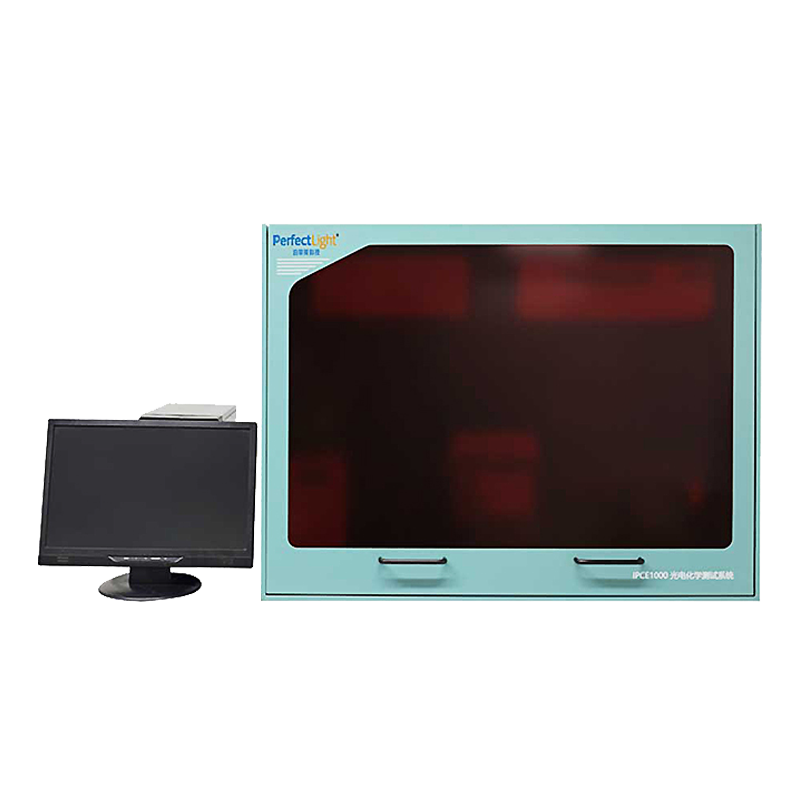
In addition to signal sensitivity, the accuracy of monochromatic light is also a fundamental pillar in constructing an IPCE evaluation system. The **IPCE 1000 photoelectrochemical testing system** employs a dual-grating monochromator design, ensuring that within the 200–1000 nm broad spectrum range, the wavelength adjustment step is precise to 1 nm, and the half-bandwidth is strictly controlled within 10 nm. This superior monochromatic performance completely avoids the quantum efficiency "overestimation" or "sawtooth" deviations caused by the wide bandwidth of traditional filter-based methods. Particularly when studying heterostructured materials with multiple band structures (such as TiO₂ loaded with BiVO₄), high-resolution IPCE spectra can clearly reveal the synergistic contributions of different components in specific wavelength bands, and even allow the determination of intrinsic bandgap changes and sub-bandgap defect state energy distributions based on shifts in the spectrum’s starting point.
From a higher-dimensional research perspective, the deep application of **IPCE Internal Quantum Efficiency** is no longer limited to simple activity evaluation; it is gradually evolving into an online diagnostic tool. By comparing IPCE curves under different bias voltages, researchers can map the dynamic relationship between charge collection efficiency and depletion layer width, and thus estimate the diffusion length of minority carriers. Moreover, this system can be integrated with trace gas product detection devices, using Faradaic efficiency calculations to correlate the quantum efficiency at the electrical end with the product yield at the chemical end. This full-link evaluation paradigm, from "each photon" to "each electron" to "each molecule," not only greatly shortens the screening cycle for efficient catalysts but also guides photoelectrocatalysis research from empirical "trial-and-error" approaches to rational design based on quantum mechanical principles.
In summary, in the green energy revolution that pursues sunlight, the ultimate pursuit of **IPCE Internal Quantum Efficiency** is essentially humanity’s profound mastery of the interaction logic between photons and electrons. By leveraging evaluation platforms like the IPCE 1000, which possess digital and high-precision characteristics, researchers can find the optimal energy destination for every incident photon in the microscopic quantum world. This is not just an advancement in measurement technology, but also a key scientific foundation for achieving carbon neutrality and reshaping the clean energy system of the future.
Recommended
news