"Mapping the Quantum Efficiency Landscape of Photoelectrocatalytic Energy Conversion"
In the contemporary landscape of renewable energy and carbon-neutral technologies, photoelectrocatalysis (PEC) has emerged as a pivotal research frontier within artificial photosynthesis due to its unique ability to combine light-driven excitation with electric field regulation. For researchers, developing photoelectrodes with broad spectral response and high stability is crucial, but the core challenge lies in objectively and accurately quantifying how effectively a material utilizes incident photons at the microscopic scale. This brings us to a key diagnostic metric in photoelectrochemical research—Incident Photon-to-Current Conversion Efficiency (IPCE) testing. More than just a numerical measure of conversion, it acts as a “precision scalpel” for dissecting carrier dynamics within semiconductors and at interfaces.
From a physical standpoint, IPCE testing in PEC fundamentally probes quantum behavior under monochromatic light. A photon that drives a chemical reaction must undergo four main stages: absorption to generate excitons, charge separation, internal transport, and interfacial catalysis. Traditional solar-to-hydrogen (STH) conversion metrics offer only a “black-box” result, whereas IPCE testing scans the photocurrent response across wavelengths, revealing band structure information, sub-bandgap defect contributions, and charge transfer characteristics at heterojunctions. For example, when studying doped TiO₂ or BiVO₄, changes in the IPCE spectrum can directly indicate whether spectral response broadening arises from intrinsic bandgap modification or the introduction of new surface states or defect levels.
However, acquiring high-quality IPCE data in practice faces significant physical noise challenges. After monochromator dispersion, the light power is often reduced to the microwatt or even lower range, producing photocurrent signals at the nA or pA level, easily masked by environmental light interference or electrolyte fluctuations. Capturing these fleeting charge flows requires a modern testing platform with extreme sensitivity and anti-interference capabilities. In this context, the IPCE 1000 Photoelectrochemical Testing System demonstrates its technical advantage as a precision evaluation tool. By integrating a US-made lock-in amplifier and high-precision chopper, it exploits signal time correlation to lock and extract weak signals. With a current detection limit down to 1 pA, the system effectively filters environmental light and current fluctuations, enabling high signal-to-noise ratio IPCE mapping even for low-efficiency UV-responsive or ultra-thin electrode materials.
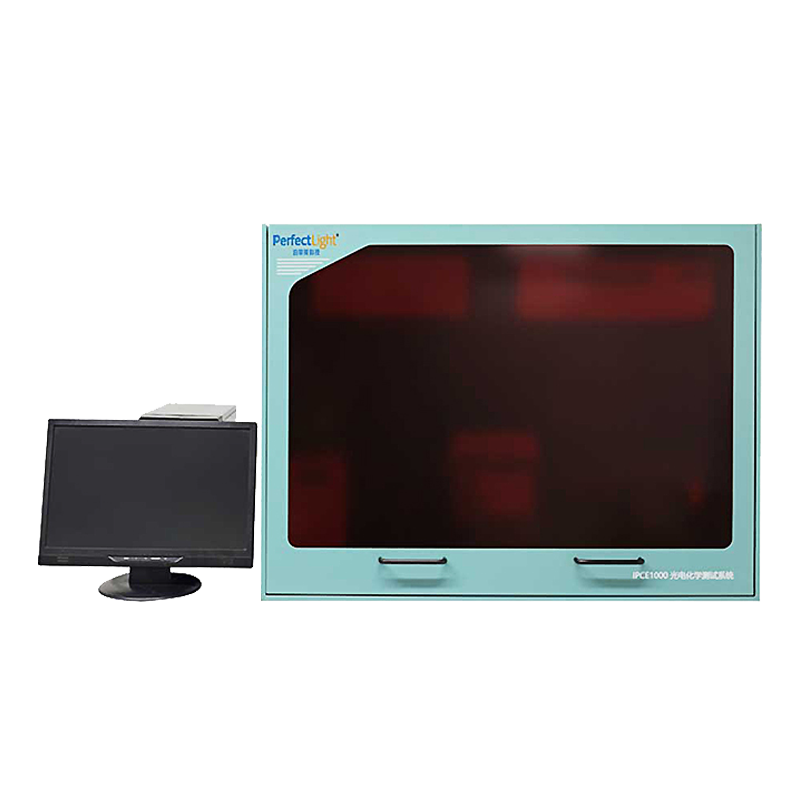
Beyond signal acquisition, spectral monochromaticity and accuracy are fundamental to testing rigor. The IPCE 1000 system uses a dual-grating monochromator with a wavelength step size of 1 nm and a half-bandwidth strictly controlled below 10 nm. This design eliminates spectral overlap errors common in conventional “light source + filter” setups. Particularly for UV-responsive catalysts, the system’s enhanced UV output and upgraded detector sensitivity—nearly 20× intensity improvement—overcome longstanding issues of weak signals, enabling accurate IPCE curves. This deep optimization from hardware to software provides robust support for reproducible, scientific research.
Looking ahead, PEC research is moving toward multi-field synergy and in-situ monitoring. Scientists are exploring how quantum efficiency changes under magnetic, thermal, or specific chemical environments. By integrating modular platforms like IPCE 1000 with real-time infrared or mass spectrometry analysis, researchers can trace the complete pathway of photogenerated charges to products. This meticulous tracking of “every incident photon” not only shortens the timeline from rational material design to engineering validation but also lays a precise data foundation for building a low-carbon, solar-driven industrial future. In the relay race of harnessing sunlight, this deep analysis of microscopic efficiency is a crucial step toward scientific truth.
Recommended
news